About Me

My photo
Welcome to the online blog for traveler/writer/photographer Steven Barber. Come in. Relax. Take off your shoes and socks -- or any other article of clothing, this is the internet. Have a look around. I hope to intrigue, amuse, entertain, and maybe provoke you just a little. I love to find adventure. All I need is a change of clothes, my Nikon, an open mind and a strong cup of coffee.
Showing posts with label movies. Show all posts

Tuesday, May 16, 2017

LOS ANGELES, CALIFORNIA - WARNER BROTHER STUDIO ENTRANCE 4


It's funny. I live in one of the most dreamed about spots in the world, and yet it's rare I think to post shots of Los Angeles and environs.

We all know the term Hollywood as it refers to a district of Los Angeles. 

("What? I thought it was its own city!" Nope, sorry.)

What may surprise you further is that only one of the legendary film studios is actually IN Hollywood. Paramount Pictures. The other studio lots are sprinkled throughout the city and the San Fernando Valley.

The film LaLaLand partly takes place on the lot below. It's the Warner Brothers lot in the Valley, wedged between Universal and Disney.  Behind it are the wilds of Griffith Park, and beyond the hill lies Hollywood proper.


Thus endeth the movie studio lesson for today.


Saturday, August 27, 2016

GOURDON, FRANCE - A MOVIE MOMENT


This next week I'll be posting a blog entry I've tentatively entitled "Familiarity Breeds Affection" which will discuss the effect of being somewhere versus imagining what it "must be like". If that's confusing, wait until the entry. Should be clearer (I hope).

But in the meantime it's a fun moment when I'm watching a film or tv show which suddenly appears in a place I've been. That I may have a little bit more than passing familiarity with.

In the last couple of months my wife and I have been watching a series of film classics. Movies such as THE AFRICAN QUEEN; PSYCHO; ARSENIC AND OLD LACE; BLADE RUNNER (Director's cut); VICTOR/VICTORIA and others.

This last Tursday night we watched one of my favorites: TO CATCH A THIEF with Grace Kelly and Cary Grant. It's a marvelous film in so many ways, and takes place on the French Riviera. And yes, some of the fun is being familiar with the locations now that I've visited the area, an enjoyment not open to me on previous viewings.

One of the most fun is only fleeting, but at one point the camera trains its eye on the hilltop town of Gourdon (below), in the Maritime Alps. It's a wonderful little town, and one of the most memorable meals we've eaten was a lunch in small bistro overlooking the mountains.

It's ne of the best perks of travel: a personal relevance to the locations we see in films.

But more about that later.


Thursday, August 25, 2016

LOS ANGELES, CA - BACKSTAGE


Backstage on the Paramount Pictures lot.

You may recognize that sky-like backdrop from quite a few films taking place on the high seas. There is a lower section of the parking area here that can be sectioned off and filled in with water, creating a quite convincing "high seas" set right in the middle of Hollywood.

Although there are handful of smaller studios in the are, Paramount is the only "major" to have a studio in Hollywood itself. The others are elsewhere in the LA metro area. (21st Century Fox is in West LA, Sony and Columbia are in Culver City, while Warner Brothers and Disney are in The Valley.)

 It was a cloudy day during this visit, greatly enhancing the effect of the "sea wall".


Saturday, April 23, 2016

MANHATTAN


There are tens of thousands of train stations around the world, ranging from the very opulent to the very humble.

And then there's Grand Central Terminal in New York. 

Some stations are far busier. Some stations are far "grander". 

But none is more iconic.

It appears in legendary films such as North by Northwest, The Cotton Club, Arthur and even featured as the setting for a dance number in Terry Gilliam's The Fisher King.

Grand Central Terminal, Manhattan, New York City.


Thursday, March 10, 2016

Film Sites: Location, Location, Location


"Cartagena? Angel, you are hell and gone from Cartagena. Cartagena's over there on the coast."

                                              - Michael Douglas, Romancing the Stone


Because we live in the Los Angeles area, we see a lot of filming for television and movies. Just part of the experience here. Long Beach, my home town, is a hotbed for production given the city's diversity of looks and neighborhoods. You've seen "The LBC", as we are called in rap culture, in many shows and films, playing everything from a midwestern small town to Miami Beach. (Both Dexter and CSI Miami shot the majority of their external scenes here in the LBC.)

But we are exposed to the film industry all over the LA area.


As such I am working, very slowly, on a photography article for the Project Torchwood website, detailing for them the filming sites for the 2011 cable tv show TORCHWOOD: MIRACLE DAY. It's a slow process, and I'm roughly 2/3rds of the way through (though I suspect that much progress will surprise even them!).

In previous columns I have written about the impact films and television have on the public's perception of places, and how, more directly, films (and tv) altered and invigorated my own perceptions of travel and different cultures.


But if I am to be truthful about it, rare are the movies (and tv shows) in which the location of the action is itself a character in the story. As much as I love the Bond films, and as much as they fed my youthful desire to see exotic places, the locations of these films are not really more than window dressing. It's not essential for Bond to be on a particular Caribbean island. Or European city. Or Asian city. They're all there solely to show you how cool Bond is, and how big his world is.

The locations don't drive the stories, they simply are background against which the story evolves.

Some films, however, rely upon the location to itself be a character. It frames the story and is an essential element of it. The story could not be told in another location without significant rewrites.


Taking as our example, the scene in MISSION:IMPOSSIBLE -- GHOST PROTOCOL where Tom Cruise's character of Ethan Hunt dangles precariously from the upper floors of the Burj Khalifa building, currently the world's tallest. The argument could be made that scene HAD to take place in Dubai, given that's the location of the building. But Dubai isn't actually a character, it's a location. Cruise could just as easily been dangling from the Petronas Towers in Singapore; the Eiffel Tower in Paris; or the Seattle Space Needle. Each could have fulfilled the role of location, and the story would be essentially unchanged.

On the other hand, as I have written before, the locations in the movie UNDER THE TUSCAN SUN are essential to the plot. They drive the narrative and are themselves characters in the movie. Simply moving the movie's location to Antigua, Guatemala -- a similarly historic and vibrant location -- isn't possible. The dynamics would change as would the story.

The tv series I mentioned before, TORCHWOOD, takes place to a very large extent in Cardiff, Wales. And that city is very much party of the overall look and feel of the show. Cardiff was itself, over the first three series, very much a character.


For the film side of things, where the budgets are bigger and the production more elaborate, it's the smaller, more intimate movies which allow the location to thrive and become something more than a simple canvas for the story. Batman has his Gotham City, and STAR TREK IV needed San Francisco as their modern day setting. But the Bond films, TRANSFORMERS, the FAST AND FURIOUS franchise, and so many other big budget movies could be transplanted without damage to the plot or visuals.

But the smaller, more intimate stories often rely heavily upon the location to give the audience a view into the characters. PACIFIC RIM doesn't really need Hong Kong to destroy. It could take out Tokyo or San Francisco or New York. All it really needs is a waterfront city with bright shiny lights.


On the other hand, George Clooney's THE DESCENDANTS would be lost without Hawaii, and a completely different story altogether if moved somewhere else. Sherlock Holmes without London wouldn't be Sherlock Holmes in anything more than a name. (A quick comparison of the BBC's SHERLOCK and CBS' ELEMENTARY demonstrates the point perfectly. Elementary's main character is as much Sherlock Holmes as was primary character Dr. House in the tv series HOUSE. A kissing cousin, perhaps, but not Sherlock himself.)

The very best films are models of connectivity. The characters, the locations and the story all have to coalesce into a cohesive and compelling experience for the audience.

Some of my favorite movies -- ignoring television for the moment -- are those in in which the location is as much a character as the people are. Oh, and if you catch that two of the movies feature Kathleen Turner, it's completely coincidental. Completely.

Some examples.

The aforementioned UNDER THE TUSCAN SUN (about which I've already written extensively).


THE DESCENDANTS


This film, starring George Clooney, takes place on the Hawaiian Islands of O'ahu and Kaua'i. The locations play a fundamental part of the overall storyline, as do the typically Hawaiian characters within the film.

The plot deals with an extended family with a multigenerational history as descendants of Hawaiian royalty. They collectively own a vast area of undeveloped acreage on Kauai, which is the subject of intense intra-family debate. Some relatives want to sell and collect their millions, others want to honor the family tradition.

As such, the location is deeply integral to the storyline, and the islands themselves become aspects of the story, not just background. If you haven't seen this film and have never been to Hawaii, this will give you a taste for the islands like few other movies have managed.


NOTTING HILL


Notting Hill is what Americans would refer to as a suburb of London.It's a wonderful little pocket neighborhood with an artistic side. It's the site of the nearly two-century old Portobello Road Market, while at the same time full of of trendy shops and culinary hot spots.

The film of the same name honors that location and tradition. While Hugh Grant and Julia Roberts emote in the foreground, the Notting Hill district plays more than simply a backdrop. Todays' Portobello Road is both traditional (Hugh Grant's character, a bookseller) and cosmopolitan (Julia Roberts', a Hollywood actress). Notting Hill is the mesh of the old and the new, providing a unique playground for the characters at first seemingly very disparate, but by the edge finding a way to integrate their lives and their values.

Much like Notting Hill itself.


ROMANCING THE STONE


There is no pretending that the Colombia of this film is the Colombia of today. Nor is Cartagena anything like the small city with rough edges.

But the movie relies heavily upon the Colombia which existed at the time, and it would be nearly impossible to relocate the story to another place. There is a danger and mystery to Cartagena, so very intense in the 1980s, that continues to this day, though it's enshrouded by a friendly and cosmopolitan veneer that shows that the city -- and the country -- are stepping into the 21st century.

The film deals with kidnapping, drug deals, nefarious and mysterious strangers, and the theft of a massive emerald. Colombia's countryside, traditions and people are a key element to the story which plays the stereotypical South American drug lord culture against the sleek streets of New York City.

Cartagena of today is vastly different from the city in the movie, but when watching the movie and then comparing it with the modern day, you can still see some of the rough around the edges.


CROSSING DELANCEY


New York has long been the subject of little films which take place in a handful of streets in one neighborhood. Most of Woody Allen's films are that way. There used to be a joke that the humor in his films was really only understandable if you came from a four square block area in midtown.

Crossing Delancey makes full use of the Lower East Side of Manhattan. The location of the film is essential. A good portion of the film's story revolves around the clash between classic New York values and what would likely be called "New York intelligentsia". Amy Irving's character isn't interested in a particular man because he seems too traditional, too reserved for her: her world is much more about books and writing and parties in Midtown. She imagines herself attracted to a famous author (Jeroen Krabbe), rather than the humble pickle salesman (Peter Riegert).

But in the same way the two aspects of Notting Hill, above, frame that story, the difference between characters in this film are reflected by the aspects of New York as a whole. The traditional values of the Lower East Side win out over the transitory and shallow world of Midtown.

In that regard, there are few other cities in which this story -- relying upon decades of viewer familiarity with these neighborhoods of New York - could be told.

L.A. STORY


Okay. The title gives it away. This one is pure L.A. and relies so heavily upon the city's neighborhoods and known stereotypes that to transpose the story to another place would be an impossibility. Whole scenes rely upon "L.A." for their impact. The earthquake. The freeway sign. The freeway shootings. The colonics.

The main character is a weatherman who, unfortunately, relies a bit too heavily upon Southern California's renowned sunny skies. His love interest is a British woman who, sadly, just doesn't understand L.A. at the beginning.

Steve Martin captures the city and the vibe beautifully, allowing those of us who live here to recognize those sillier parts of ourselves without being mean about it.

As a love letter to a one-of-a-kind city, this is second to none.


BODY HEAT    


One of the last truly great film noir movies, Body Heat is a tremendous movie in which Florida's vaunted heat and lifestyles play into the story itself. Evocative of such other great movies such as Key Largo, Body Heat ups the...well, heat. Both from an intensely physical way, to the environment of Florida's oppressive summer months.

Heat. Humidity. Stifling nights, and characters right out of a Sam Spade story, Body Heat captures seductive Florida, allowing the characters of the film to play against an interactive and visceral environment, not just a movie set.


Thursday, July 16, 2015

Pic of the Day: Birds of a Feather


This dark and enigmatic photo was taken at a park just before sunrise on a misty morning here in Long Beach.

I enhanced the contrast and converted it to B&W -- my hope is to echo the mood of the 1930s film noir movies in a scene vaguely reminiscent of "The Birds".


Friday, April 24, 2015

THE EXPLORER IN ME


"What intrigues me the most are those things in the distance, on the horizon. That is where I want to go; what I want to see next."


As I write this I am on a Westbound flight from Charlotte, North Carolina, to Dallas. There I'll make a connection to my eventual destination of Santa Ana -- more commonly known as John Wayne Orange County Airport.

Me in Japan, ca 1965
Join Wayne is my second preferred airport in the LA metropolitan area, at a time when my definition of "preferred" has a different meaning than it did a decade or so ago. Back then I didn't really give much thought to which airport I was using, just the flights and getting to the destinations involved. If I needed to get from Point A to Point Z I simply selected the flight and made my way to whichever airfield the arrangements required.

Atop Mt Haleakala
In many cases this default airport was LAX. And to give the giant monster its due: there is an excitement and energy level in flying from LAX that doesn't really exist at the smaller fields. But it's not just size -- I don't get the same "vibe" from equally large facilities such as DFW or PHX. But I do from others like MSP or JFK. 

(My favorite airport, Long Beach, was at the time still involved in a decade-long local legal morass on noise reduction -- which seriously hampered any airline from doing much, basically killing it as an option for me...thankfully that's no longer the case.)

The Mendenhall Glacier
The ruins at Tulum
I'm certain it's a personal perception, and once again I have to look to my childhood for influence and guidance. I truly believe so many of my ingrained more visceral responses to travel come from my early years. I've alluded more than a few times to the influence movies and television had on my perception of the world. James Bond; Casablanca (despite being filmed in a studio); Lawrence of Arabia; It Takes a Thief; The Saint; I, Spy and other globetrotting tv programs and films gave me my first true look at the world beyond my front door, and I learned an excitement that came from realizing that I, too, could visit all those exotic places. 
(It didn't hurt that my parents were fans of those sorts of programs. Their influence was more profound than television, though more subtle in many ways. Dad, who was a career Naval officers, would send us postcards and pictures from around the globe as his various deployments took him from one exotic port to another. Hong Kong still looms large in my imagination precisely because he and my mother met there a few times while we kids sat at home, dreaming of what it must be like. It's still on my NOW list to this day.)

Polar Bears on the tundra
Then came things -- worldwide news events like The Olympics -- which showed me in realtime what the world looks like. And the nightly news, when "nightly news" actually meant News and not Entertainment. The Huntley-Brinkley Report was the family go-to, and their reporters around the world again brought exotic places and unpronounceable names right into our family room. 

Times Square
Today the world seems to have become much smaller. Much more everyday. The popularizing of air travel, and the ubiquity of broadcast programming, means things are becoming a bit more homogenous. Unless you looks specifically for the differences, Des Moines isn't all that different than Charlotte, except for the plants. 

Alleys in Croatia
(On this particular trip I stayed in a very nice Marriott, and had dinner at a very nice regional chain restaurant -- both of which were not terribly different from places I stayed at and dined at in places like Seattle or Albuquerque. Quite nice, but nothing that screamed "you're in the South!", even though the restaurant billed itself that way...)

But exploring the world still holds a mystique if you know where to go and where to look. 

The Great Barrier Reef
Travel expands the mind, or so the saying goes. I have yet to meet very many open-minded travelers who are not citizens of the world and who understand that what exists outside their front door is only an infinitesimally small part of the whole. 

As I sit here at 35,000 feet I look down at the world below, one which I have only just begun to explore, and wonder at what is down there. What cool stuff lies unexplored and waiting for me? 

That is what I want to find out and what drives me to my next destination.

That and the coffee, that is.


Driving in the Mojave Desert volcanic fields
Hell, Cayman Islands


The Explorer in Me - Where next?


Friday, May 31, 2013

ROAD PICTURES


“Wandering around our America has changed me more than I thought. I am not me any more. At least I’m not the same me I was.”
Ernesto Guevara de la Serna in “Motorcycle Diaries


Hooray for Hollywood!
I have remarked a few times on the impact that the James Bond series of movies and the various television shows I watched as a child had on my development into a person who loves travel. How the visuals and locations excited me as a young boy, and gave me the basis for valuing -- and wanting to go to -- "other places".

Over the years, films have played a large role in not only my life, but the lives of others. Making a list of favorite, best, and most influential travel films is as frequent as the debate over what, exactly, constitutes a "travel film".

For me, the location has to play an important role in the storyline. It cannot simply be the background -- I usually ask myself if the film could have been set anywhere else. If the answer is "no", then it's a travel film in some way. It evokes a sense of place and this somehow reflects in the overall storyline. The list below is far from comprehensive, and ignores other potential inclusions such as Captain Corelli's Mandolin;  The African Queen; Grand Prix (or LeMans for that matter); Romancing the Stone and a multitude of other wonderful films over the years.

Paris, An American in Paris

Another factor has to be that it shows the locale in something of a positive light. It has to, in some way, appeal to your sense of adventure or at the very least make you want to explore the setting(s) in a bit more detail. It does NOT need to be filmed on location, though for obvious reasons it helps. Two of my choices below were filmed on sound stages, but I will explain my thinking in more detail below.

But what these films share is an understanding of their environment and how much that environment can impact ourselves. In some of them the setting is a tapestry against which the action takes place. Would the biplane attack in North by Northwest have been as terrifying in a city or in a forest instead of on the Great Plains? Unlikely. The open space left nowhere to hide, leaving the main character exposed and vulnerable. 

Some of the films concentrate on their setting. Encounters at the End of the World is about Antarctica. As the only documentary in my list -- documentaries being a 'too-easy' category of films for this sort of list because they are exactly about locations and settings...it defies the central idea of film stories which motivate you to travel without being themselves explicitly about the destination -- it differs from the majority of "This is Antarctica" documentaries because it deals with the people who themselves have to contend with the environment and how that environment affects them. Yeah, that also applies to many other documentary-type films, but it's my list and I'll do it my way. (Argue with me about this and I'll trot out In Search of Ancient Astronauts to silence you once and for all!)

New Orleans, Cat People
This list does not contain solely films which had their affect on me as a child. Some of them did, but others served to reinforce my thinking as I grew and as I matured (some would tell you these were not simultaneous events). In a way, some of them have not yet materialized for me. I have not yet been to Antarctica, Wadi Rum, a Venezuelan plateau or the Amazon, though they all feature prominently in films below. They're still targets for the future.

Cortona, Under the Tuscan Sun
Finally, the shots I've used for this blog entry are from places I have been as a result of seeing them in
films. Had I not seen them, had them suggested to me, chances are they would never have been a chosen travel destination. All of the places you see photographed here came to me at some initial moment in a darkened movie theater. I found my way because some way, some how I saw them in a film and when it came time  to plaAnd not for the last time, either. I've cited what I think the inspirational film was, and even if I'm wrong you'll never know the difference. Life is funny like that.

So, all this in mind:

My Top Ten Travel Films, in no order of any kind

Under the Tuscan Sun - Commonly tossed aside as a chick flick, this is actually a pretty inspirational travel film. It features, of course, the town of Cortona in the Tuscan hills. The director of the film chose, rightly, to film the big city scenes in cool, blue gray tones which nicely offset the lively colors of Tuscany. This is a film about a character getting back in touch with her own self, restoring a sense and balance. Finding our own life balances is a task which all too frequently get brushed aside by daily activities which consume us and risk turing our world into that blue gray mess. Cortona, and to a lesser extent Positano (a picturesque town clinging to the side of the steep Amalfi Coast, are lessons in that balance, of taking the time and making the effort to establish connections and appreciate the world around us.

New York, North by Northwest
North by Northwest - A travel film? Really? Yep. New York and the Great Plains are but two of the locations in this film. The third, of course, is Mount Rushmore. Throughout the movie each contributes not only a setting, but a mood. As I noted above, I cannot think of a better spot for the biplane attack than the Plains. New York is shown as a vibrant, energetic place in complete contrast to the isolation of the Plains and the majesty of Rushmore. It typifies the Metropolitan New York of the 'forties, 'fifties and 'sixties. In this film, each setting establishes both the mood and the action.

UP! - Oh, who wouldn't want to pack up the house and move to a South American tepui (plateau) in search of adventure? In this case, the animators relied on their own travels to Mount Roraima as inspiration for the film's second half. The otherworldy landscapes and tremendous waterfalls are real, and the film uses them as the basis for the protagonist's dreams and then his reality. The message of the film is that paradise does exist if you're open to it.

Roman Holiday - The name of the film kid of gives it away, but a good deal of the plot revolves around  a princess who has escaped her overwhelmingly structured life for a chance to stop and appreciate the world around her. There is a good deal of travelogue-style footage of Rome, but also an attempt to show the lifestyle of an American expat/reporter living there. Much is made of the magic of Rome, including its romantic allure.

Rome, Roman Holiday
Aguirre: The Wrath of God - The Amazon is a full-blown character in this film, and I do mean character. The human search for gold, more accurately Eldorado itself, plays out against the jungle and river in a way that reflects badly on the men involved. As their pursuit descends into madness, the river becomes more than a conveyance, it becomes an implacable force demonstrating man's folly. Why, given all that, would it be a good travel film? Because the river and jungle are spectacularly beautiful. One gets the impression that if given the proper respect the region is full of adventure and opportunity -- just don't look for any lost cities of gold...

Raiders of the Lost Ark - I don't think I even need to go into detail on this one. One adventure after another, and all against a series of settings which look all the more romantic in the rose colored historic glasses Spielberg used to make it. From the Himalayas to the desert surrounding Cairo, the world itself is the playground complete with dotted lines on a victorian map as we transition from one exotic locale to another. 
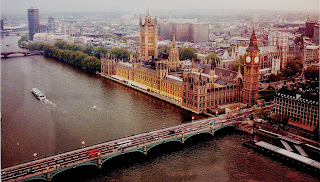
London, Mary Poppins

Mary Poppins - 
No, I have not lost it. The London depicted in Mary Poppins does not, and never did, exist. I am thoroughly aware of that. But it is a fantasy version, an idealized London not dissimilar to Disney's Main Street as a stand in for the real thing. There is room for the imaginary version of a place to act as a motivator to see the real thing. The Paris of An American in Paris is a comparable setting, and yet both films manage to create such a vivid and three-dimensional fantasy that it inspires the viewer to want to go there. (The expectation that what you will find there is the only variable, of course. If you expect to find an imaginary Victorian London, then it is the expectations which are off, not the motivations.)

Lawrence of Arabia - When it comes to exotic and well-filmed locals, Lawrence of Arabia is perhaps the king of all travel films. David Lean used the desert as both a test of the characters, and a framework by which to define them. Visually he took the time to create the Arabian landscape in such a way as to bring it alive for the viewer. Not just a setting, a world into and of itself. For me it has inspired a desire to get to Wadi Rum and sleep under the stars. Though a demanding land, it also seems quite spiritual for the person who is open to such things. Lawrence was forever changed by the land and its people, and perhaps it can have an echo of the same impact on a modern day traveler.

Encounters at the End of the World - As I mentioned above, this is the only documentary in the list. It isn't a travelogue, however. It's the story of the people there, and how they are impacted and challenged by the frozen continent. In my own mind, it makes me want to go there, to not only visit but experience. Someday...

The Bing Crosby, Bob Hope Road Pictures - No discussion of inspirational travel films would be complete without a nod to the entire "Road to" series of films from Hope and Crosby. Yes, filmed on sound stages, and certainly not much more than recycled gags and plotlines set in different exotic locales around the world, the Road pictures were fun little romps which celebrated other cultures by depicting two everyday guys as stand ins for ourselves. Oftentimes the story would revolve around some sort of intrigue that the boys became innocently involved in -- with Dorothy Lamour somewhere in the mix. In their own way, and in a much more humorous vein, the Road pictures were distant cousins to the much later and far more serious James Bond films. Villains, heists, heroines and attempted murders were usually the order of the day, yet the boys managed to overcome the odds and set the world to right again. All seemingly accomplished while riding camels and singing in the Moroccan desert, and that seemed like just a whole lot of fun all the way around.


-------------------------------------------


So, it's an unusual list in several ways, but if it matched every other kind of list made up by everyone else what would be the point?

We all learned, at some point in our lives, to want to travel. To go find new places to go and new things to do. The inspiration for this comes from a multitude of sources, not the least of which is the Silver Screen.


Positano, Under the Tuscan Sun