About Me

My photo
Welcome to the online blog for traveler/writer/photographer Steven Barber. Come in. Relax. Take off your shoes and socks -- or any other article of clothing, this is the internet. Have a look around. I hope to intrigue, amuse, entertain, and maybe provoke you just a little. I love to find adventure. All I need is a change of clothes, my Nikon, an open mind and a strong cup of coffee.
Showing posts with label far north Queensland. Show all posts

Thursday, July 20, 2017

BEACHES - MYALL BEACH, CAPE TRIBULATION, QUEENSLAND


Beaches come in all shapes and sizes, from the very tiny (Poipu Beach, which we featured on Monday) to the vast and beautiful Piha Beach in New Zealand (tomorrow's selection).

Australia is no slouch when it comes to sand and surf. And in the Daintree Rainforest, in what is often referred to as the "Effen Q" (FNQ, Far North Queensland), there are several beautiful and quite empty shorelines for the adventurous visitors. Myall Beach, located in the national park menacingly entitled Cape Tribulation, is a remote and yet accessible stretch of sand. Swimming is discouraged.

Then again, they may be a bit busier when the weather is more compliant. The advance system from an incoming typhoon (still many hundreds of miles from shore) lends an ominous touch to the surf and clouds. The rugged rocks add to the ambience as the rainforest threatens to spill into the ocean.


It's an intimidating place; empty and spectacular.


Wednesday, August 24, 2016

PORT DOUGLAS, QUEENSLAND - SWIMMING NOT PERMITTED


Drifting along in Packers Creek, Far North Queensland (the FNQ), adjacent to Port Douglas.

No swimming, for what will soon be obvious reasons.


Friday, May 20, 2016

SUNRISE, SUNSET


“There's always a story. It's all stories, really. The sun coming up every day is a story. Everything's got a story in it. Change the story, change the world.” 
                  

                                                               ― Terry Pratchett, A Hat Full of Sky


It seems appropriate that I am writing this entry in the pre-dawn hours, tucked tightly into a cocoon of darkness. In just a little over an hour, as I write this, the sun will rise and a new day will begin.


Sunrise, Long Beach, CA
Sunrise is a magical time for many of us -- though I'll laughingly admit there's a large group of Americans who only theorize about sunrise, having never actually witnessed one for themselves. But the slow ascent of day, the gradual brightening of the sky to the East, with the sounds of birds as an accompanying orchestra, is one which when you pause to observe is a wonderful thing.


Sunset, Dana Point, CA
Likewise, at the end of every day the mirror of the dawn occurs: dusk. When the sun retreats back into the night and we all pack up our lives for a short time and rest to await the next day. Well, many of us rest...and that kind of depends upon which day of the week it is.

Both dawn and dusk are favorites for photographers. The lighting is dramatic and intense, giving us both inspiration and opportunity. Either directly shooting the sun as it rises or descends, or using the light from it as it falls upon some other target of our attentions.


Sunrise, Mt Haleakala, Maui, HI
I have been fortunate to have seen some truly spectacular sunrises and sunsets -- including a few of them which qualify as "Life Events". Seeing the sun rise from the top of Mount Haleakala in Hawaii was a truly inspirational moment, which I've described here, with the beauty and intensity of the sunrise over the massive volcanic crater, accompanied by the beautiful voice of a Hawaiian singer greeting the new day with a song.


Sunset from Mallory Pier, Key West, FL


Party time...
The carnival atmosphere of a sunset in Florida's Key West as seen from Mallory Pier is a fun and festive event as hundreds of people gather to watch a flotilla of sailboats dance across the horizon as they're silhouetted by the retreating sun.

Bodies of water seem to be appropriate canvases for the breaking of day or setting of the sun. The reflective nature enhances and frames the sun in a way that is remarkably profound and -- thankfully -- quite photogenic. And it oftentimes is an event which we will remember long after the sun has set and we've returned to our regular activities. It's a moment of pause, of -- pardon the pun -- reflection.


Sunrise on the tundra
As a photographer I have been to and seen many different spots in this world, but inevitably some of the most impactful moments have been in the very early morning hours when I walk, usually alone, around a place as it slowly wakes up. To see the sun as it comes up over the ocean, or a mountain, or the flat expanse of the Canadian tundra. Sunrises are mostly solitary events.

Sunsets are communal, shared, and more celebratory in a way. It's not the end of the day for many people, just the ending of daylight. As such, watching the sun go down is a group effort, while the sunrise is not. There may be one or two other souls who have similarly gotten up early, grabbed a cup of coffee and wandered out to see the morning's light. I described one such sunrise here.

These are some of my favorite places to see the sun awaken and also fall to sleep.


Sunset, Grand Canyon, AZ

Last vestige of light over Joshua Tree NP, CA

Sunset aboard the MSY Wind Surf - Adriatic Sea

Sunset, Hanalei Bay, Kauai, HI

Sunrise, Monument Valley, AZ/UT

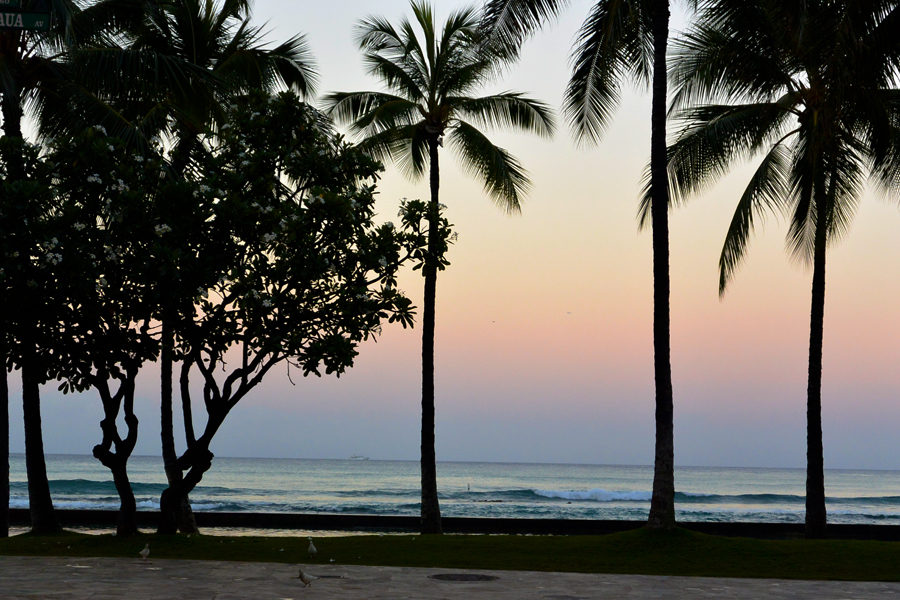
Just before sunrise, Waikiki Beach, Honolulu, HI
Sunset, Washington, DC

Sunset, Nice, France


Sunrise, Port Douglas, Queensland, Australia

Sunrise, Sedona, AZ

Sunset, Santa Fe, NM
Sunset, Las Vegas
Sunrise off the coast of Mexico

Sunrise, Cayman Islands
Sunrise just off the coast of Panama


Sunset, Cartagena, Colombia


Sunset, Kona, Big Island, HI


Tuesday, February 23, 2016

THE DAILY ESCAPE: Time for Tea


High tea is always an enjoyable afternoon, pretty much no matter where you have it.

This wonderful little tea and cheese repast was in the Daintree Forest, Far North Queensland, Australia. 


Sunday, November 8, 2015

Pic of the Day: The Kuranda Sky Rail


The Far North Queensland market town of Kuranda is situated in the mountains roughly halfway between the city of Cairns and the smaller, more intimate resort of Port Douglas.

There are two major ways to get to the town. The SkyRail, pictured here, is a multi-mile long gondola ride involving three transfers and quite a bit of dizzying heights over the rainforest canopy below.

The second major route (there are roads, but those are largely not used by tourists) is via the Kuranda Scenic Rail Line, a train which winds its way up the mountainside past the Kuranda River and into the station at the foot of the town.

On the day we were there the SkyRail was a madhouse. The staff were overwhelmed and lines were hours long. Nobody knew why. It eventually came to light that someone -- a local mind you -- had tried to cross the train tracks in front of the oncoming train. As it usually does, the train won. But it also meant an investigation, etc.

So all the train passengers made their way to the rail line and the system was overwhelmed.

However, once we were airborne, and I was able to get my acrophobia to quiet itself down enough to enjoy the view, the journey was spectacular.

Below is an empty gondola headed back down the hill to retrieve more visitors.


Tuesday, May 20, 2014

THE GREAT BARRIER REEF


"Look deep into nature, and then you will understand everything better." 
                - Albert Einstein


It has been on our No Opportunity Wasted to-do list since the first lists we made back in 2007. 

The Great Barrier Reef conjures, in our mind's eye, hundreds of images and emotions -- in particular, for many fans of Disney movies, the stunning visuals from Pixar's beautifully made film FINDING NEMO. Or, if you're older, perhaps it's Disney's 20,000 LEAGUES UNDER THE SEA.

Regardless, we all have our images which are conjured up simply by the name: The Great Barrier Reef. Or its geographic corollary, the Coral Sea.

The Reef itself is certainly one of the world's "legendary" natural wonders, alongside such landmarks as The Grand Canyon, Victoria Falls, Mount Everest and the harbor at Rio de Janeiro. As a traveler I find myself more enthused and impressed by natural wonders than I am by those

man-made, though certainly there are spectacles with our human thumbprints on them. The grandeur of nature, however, never fails to put mankind in our place, and I love that.

Queensland, along the northern eastern seaboard of Australia, is a diverse and beautiful part of the world. For our visit we chose to bypass the city-like Cairns area, favoring instead a short jaunt north to Port Douglas, a wonderful little seaside town with a laid-back and decidedly tropical flair.

We stayed for four nights at ...By The Sea Port Douglas, our little inn at the beach while in Far North Queensland. (We were amused at the label "The FNQ" as pronounced by most Australians -- more like Effen Q, and not entirely by accident.)


The beach at Port Douglas, just steps from the inn
The inn is perfectly situated within an easy walk to the beach, as well as just a few minutes on foot from the primary shopping and dining district in Port Douglas, along Macrossan Street. The rooms are quite nice, and the views of the tree-lined beach from the third floor are tremendous. The only caution is that the inn does not have a lift, which makes luggage a challenge and any kind of physical impairment a challenge for the upper floors. Still, the location, property, and people make the inn our first choice next time we head back to the FNQ.

Our adventure on the Reef began early in the morning, as the shuttle for Calypso Reef Cruises arrived at the inn to pick us up. The staff at ...By the Sea had equipped us with towels, and the Calypso had the rest of what we needed. I packed only my brand-spanking-new Nikon AW1 underwater camera for the voyage. I'd bought it specifically for this trip, and was excited to see what kind of results it would yield. (And, to be honest, a bit nervous about dunking a thousand dollar camera into salt water...but more about that later.)

A few minutes later we were deposited at the marina, and escorted down the short pier walk to the Calypso, a double-hulled 25 meter vessel designed for snorkeling and scuba tourism. Given the rumors of rough weather later in the day, I was pleased to see a fairly large vessel with a competent crew.


Leaving Port Douglas
We boarded The Calypso, removed our shoes and were encouraged to make ourselves at home. As we arrived we were evaluated and fitted with flippers, snorkel gear and a wet suit. It was explained to us a little later that the water wasn't cold, but that suits were required because we were at the very end of the jellyfish season. The suits would protect us from stings should we meet up with one of the locals. Of particular concern, of course, are Box Jellyfish, among the deadliest in the world. Again we were reassured that it was extremely unlikely we would encounter anything of concern.

Not long after casting off the crew conducted an introductory review of the day and safety regulations. We got to know a few of the other passengers, most of whom were from around the world. (Britain and Australia, naturally, dominated the passenger manifest.) As we made the hour and a half voyage to the Outer Reef, people congregated on the first and second levels -- and a few tanning types made for the third deck sunlounges. morning tea was served and we all chatted excitedly about the day before us.


Not much to look at...
Despite the distance, it seemed we arrived before too long. Since the Reef, of course, is underwater, the only suggestion of a destination is the brown shadow in the water below. The arrival is almost uneventful as the captain selected his spot and the crew (carefully) dropped anchor and got the rear deck ready for the passengers.


For this particular visit, the captain had chosen Opal Reef, one of the regularly mentioned "beautiful" sights/sites on the Outer Reef. Despite its reputation only two boats -- ourselves and one from Wavelength Cruises -- were present, both giving wide berth to each other to ensure a "private" reef experience.

As I sat on the rear deck at the first (of three) site, fins on my feet and feet in the water, I looked out at all of the other passengers who were already in the water. Holding fast to their noodles -- supplied by the Calypso to make our viewing a lot easier -- they moved slowly, fanning out and across the Reef's shadow, heads buried in the water. My wife had already cast off and was joining the group -- roughly fifteen passengers. Five others, true scuba divers, had already departed and were somewhere below.

Nervously I looked down at the camera in my hands. The moment of truth. I should note that the idea of putting a camera into water -- let alone salt water -- goes against my every instinct as a photographer. And what if I had done something wrong? A grain of sand, and speck of dust that compromised the water-proofing? All sorts of things went through my head, not the least of which was "I just GOT this!"

Sucking in air, I leaned forward and dunked the camera, probably wincing as I did so. I looked at the display. It worked normally. So I dunked it again. Again, no problem. Finally, figuring it was "in for a dime, in for a dollar" I accepted this was why I bought it and slid into the water. The camera worked perfectly.


Moments later I was fighting the waves, swimming and drifting a few meters over the top of the first section of reef. In this area the reef was two to four meeter below the surface, which partially muted the colors, but still stunned me with the variety of fish, coral and other life. For a half hour or so I pushed around the camera, making photos with and without the flash, including a handful of videos. (Later I would discover than the constant wave action made the videos a bit loopy to watch, but once I get a chance to edit them properly I will post a few at a future date.) Not knowing what to expect with underwater photography, I was covering all of the bases. Fortunately the Nikon AW1 is sophisticated enough to compensate for my inexperience in underwater photography and allowed me to produce some truly stunning shots.

Time came to pull up anchor and move to a second spot, the duration of which they entertained a few of us with a short presentation on the bow sun deck. One of the crew, a biologist, walked us through what we had just seen, and what we could expect to see at stops two and three. Despite the already-impressive views, we were assured that stop number three would be stunning.

One amusing side note: during the first and second stops, several people were slightly distressed by the presence of small jellyfish, roughly the size of a human thumb, that were floating freely through the water. Plentiful enough that they were difficult to avoid. I found myself pulling back and dodging sideways at times to avoid them...until someone asked our biologist friend about them. All of us were dreading the Box Jellyfish, so really wanted to know if we should be concerned.

"Oh, those," she said. "Nah, they're not dangerous. You can even grab one and put it to your lips for s little buzz." Un-huh. Several of us thanked her, but said this was not likely to happen. But at least we didn't have to contort ourselves unnecessarily -- looking, no doubt, like a marlin caught on a fisherman's line -- next time they drifted into view.

The second stop was equal to the first, but when we arrived and got in for the third and final dive, the change was immediate and stunning.

The first two stops were at reefs several meters under the surface. While spectacular, the colors, as noted, were muted a bit and we, being on the surface, were sufficiently distant as to make the experience wonderful, but not sufficiently different from dives in Hawaii or Mexico.

The third stop explained, in full, why the reef -- The Great Barrier Reef -- is what it is. The surface of the particular structure was a meter or so down, so that we were drifting just inches off the coral. The fish, too, were much shallower, allowing the sun's light to bounce brightly off their scales, enhancing the amazing colors. It was as if the visuals from FINDING NEMO had leapt off the screen and lay before our eyes in real life. Fitting, since that's exactly what had happened, only in reverse. At the third stop you could see the diversity, the amazing beauty of the reef in full sun-drenched brilliance. 

The experience is one no words or pictures can convey fully, but I will try. Drifting over the tops of the coral structures, you get a sense of awe, of amazement that the natural world can produce such an astounding place. Each new area brings another thing of beauty into your view. As beautiful as areas one and two were, the third one was exponentially better. All of your senses are alive, including the sounds of the water lapping in your ears and the crash of light surf on the edges of the reef. Physically you're being bounced around, trying carefully to avoid hitting of touching anything below. Your nose is clamped tight, but the light taste of salt water permeates your mouth. And visually you're on overload.

Just before climbing back onto the Calypso -- exhausted and yet energized -- it occurs to me that so rarely do you find things for which you have built up expectations over a lifetime, which then turn out to be everything you've dreamed. This was that sort of thing.

As we clambered back on board, everyone was talking excitedly and yet also saddened that the reef was now dropping behind us. A storm was blowing in, and as we took turns in the bathrooms peeling the wetsuits off (not easy in a four x three foot room), people drifted into small groups, talking briefly then beginning to stare off into the distance, as if holding onto, for one more moment, the experience. As the Calypso headed for shore the squall caught up with us, making for a rough ride in -- but somehow fitting that the sea, after showing us the beauty if was capable of protecting, was also sending us a warning regarding the fury it could produce. We could look, but do not touch.
Look...but do not touch.

The Great Barrier Reef, all 1400 miles in length, 2900 individual  reefs, 900 islands and 344,000 square kilometers of it, is truly a global treasure -- it's a UNESCO World Heritage Site as well as a recognized Natural Wonder.


And as I check this off my No Opportunity Wasted list, I have to wonder: what could possibly replace it as my next goal. 

Maybe Antarctica....


List of World Heritage Sites: http://whc.unesco.org/en/list
...By the Sea:  http://www.bytheseaportdouglas.com.au/
Calyspo Reef Cruises:  http://www.calypsoreefcruises.com/