"Travel takes more than money. It takes the most precious commodity: time. Anyone can buy a car, handbag or shoes, but travel requires energy, bravery, curiosity, and a degree of adventurousness." - Andre Balazs, noted hotelier
I include this particular quote for the end-of-the-year entry not because I want to convey anything romantic or special about the ability and drive to travel, but because I happen to agree with this statement wholeheartedly. Owning nice things is good, but having the opportunity to travel and see new things, to escape your comfort zone and go somewhere special -- for everywhere is, in its own way, special -- is both a luxury and a requirement for a wholly grounded person.
In that regard, 2012 was a good year for travel. At least for me.
It wasn't so much the distance covered (from a mileage-only standpoint it was far from the record) as it was the number of sights seen across a beautiful spectrum of landscapes. At first glance there would seem to be a lot of repetition from previous years -- only two completely new destinations -- but 2012 was an opportunity to dig a little deeper under the skin of some spots, expanding both our knowledge of the places, as well as getting a chance to do some things which we hadn't pursued on previous visits.
I mentioned, in the preceding column on Joshua Tree, that maturity has brought me the understanding that the desert possesses all the intrinsic beauty of a lush forest or a vast seascape -- and this year allowed me the opportunity to see and photograph all three of these environments (plus!). In fact, simply from a standpoint of a variety of topographical destinations, 2012 has got to be considered one of the most diverse of my adulthood.
LAS VEGAS
 The year began, as it often does, with a weekender trip up to Las Vegas for my birthday. Believe me when I tell you it wasn't all that it was cracked up to be -- again, not in the expense, but in the experience. And it's nobody's fault but my own.
Heading up the very familiar Interstate 15 -- the highway which connects Vegas to the LA metro area (though not LA proper) -- I began feeling very drained and not at all myself. To the point where I asked my wife to do most of the driving. (You should know, by now, that I love to drive, so this tells you how low I was that particular day.) Our reservations were at the Palazzo Hotel, one of the grandest properties on The Strip, and part of the stunning Venetian complex. That evening we were set for dinner at SushiSamba, a terrific little place in the hotel that serves a fabulous fusion menu of Brazilian and Japanese specialities in mostly tapas-sized portions. It can be quite a bit of fun, and the food is spectacular. During dinner I indulged with a couple of martinis, and despite my earlier exhaustion, my wife and I had a terrific time.
As we left the restaurant, I excused myself to make a quick run into the Men's room, where (as I was washing my hands) I felt the need to sneeze. Bad move. Suddenly all Hell broke loose in the form of a crimson fountain from my nose. I tried for a couple of minutes, but no luck in getting it to stop, so I clamped my nose shut with a paper towel and went out, where my now shocked wife looked at me and suggested we immediately go to the room. To make a long and unpleasant story shorter, five hours later I was in the Emergency Room being discharged with a pair of packing stents, one each nostril, looking as if I were a raccoon on the bottom end of a fight with Mike Tyson. Who knew you could overdose on blood thinners, a diagnosis my doctor made a day later when I saw her to have the stents removed -- and who knew doctors could go pale and recoil when they saw a patient with a bloody nose?
So the year didn't get off to the best of starts (though I did have a much better business trip to Las Vegas in October) but it was soon to get much better. Just a few months later -- and me securely off of anything resembling blood thinners and feeling substantially more human for it -- we got ourselves over to the Hawaiian Islands for a weeklong dive into our NO OPPORTUNITY WASTED agendas.
In that single week we managed to accomplish four separate items in various places on our lists, several of which have already been mentioned and discussed here on the blog.
THE BIG ISLAND
 |
| Southern tip of the U.S. |
 |
| Manta Rays rock! |
The first few days found us on the Big Island of Hawaii. Our primary purpose was to spend an evening swimming with manta rays off the coast of the island adjacent to the town of Keauhou. This was accomplished with stunning results, and is a memory we will keep and cherish for the rest of our lives. I detailed this in my blog entry from May of this year entitled NIGHT OF THE MANTAS. The evening was surreal and exhilarating -- there is simply nothing like floating on the surface of the ocean as these immense and somewhat intimidating angels of the deep perform an extraordinary ballet at times mere inches from your facemask. As a click off our NOW lists, this one rates among the best adventures we've had so far.
The Big Island has been a source of several NOW items, in fact. From the major to the minor. A few years ago we stood overlooking the primary Kilauea caldera, just a month before a significant eruption took place. (On the minor check-mark side, we've visited the black sand beach at Punalu'u, watching sea turtles come ashore to bask in the warm sun. This time around we journeyed to the southernmost point in the United States, then on the way back indulged in a cup of Kona coffee on one of the many private plantations which dot the western slopes of Mauna Loa.
MAUI
The second half of this year's Hawaiian voyage was to the island of Maui. After a harrowing flight between islands aboard a single-engine plane through blustery skies, we settled into our hotel on the western side of the island and prepared for a few more adventures. The resort -- the Westin Ka'anapali -- is beautiful, and has an excellent location virtually centered on the island's west facing coast. This gave us plenty of accessibility to our favorite town of Lahaina, a place we love to visit whenever the opportunity arises. From an artistic and historic standpoint, the town is full of things to do and see.
 |
| House of the Rising Sun |
Maui is home to the ten thousand foot dormant volcano, Mount Haleakala. The sunrise from atop the mountain is commonly included in most lists of the most beautiful natural sights in the world, and I have no reason to disagree. I awoke early our first morning for a 3am rendezvous with a small tour group for the two hour drive to the summit to view the dawn. My experience was recounted in my blog entry of April 29th entitled THE VIEW FROM ABOVE. There is nothing I have ever experienced quite like standing on the edge of an immense valley, facing east to watch the sun rise over the clouds. Utterly astounding.
The time on Maui yielded a few more special events which will live in our memories for years, if not the rest of our lives. We braved the waters of a perfectly safe inlet to finally learn how to SNUBA. (SNUBA is a combination scuba tank and snorkel which doesn't require a series of classes to learn. The primary difference between SCUBA and SNUBA is that the tank is not strapped to your back. It floats on the surface with a long tube connecting to your regulator.) For the forty minutes we spent below the surface was wonderful and educational -- I can see why people take up SCUBA diving, though I'm not yet sure I'm ready to make that particular leap.
 |
| Mother and child |
Later on that same trip, the captain of the tour boat caught sight of a pair of whales swimming not too far from our location, and as we pulled as close as is legal he noted that it appeared to be a mother and calf. The calf, undoubtedly to the consternation of its parent, was enthralled with the boat, playfully swimming around us and letting everyone on board get their fill of "glimpses" of a young whale. Mom was patient with all of us, but after five minutes she decided that junior was done and led him under. But for those five minutes we all enjoyed the interaction -- and someday I promise to use the video footage, in addition to the still shots shown here.
NAPA VALLEY
 |
| Calistoga in the early morning |
August found us on the road again, this time with our friends from Perth, Australia. We have begun a tradition of spending a few weeks together in some exotic part of the world -- in the past this has included Mexico, Las Vegas, Italy and Croatia. On one of the days the subject of wine came up -- a natural enough occurrence, given our proximity to Italy's famous winegrowing regions -- and our friend noted how significant Australia had become in the wine world. I agreed, but when I mentioned California's own claims to fame I was met by, essentially, a vacant expression. Australians, as we have come to find out, are not at all familiar with California's wine growing prowess. This stands to reason, if you stop to think about it. California is the prime winegrowing region in a nation of some 330 million people. Not a huge need to export the product when we have a constantly parched American palate to entertain.
So the gauntlet was thrown: come back to America and we will give you a tour of the Napa Valley that will rock your senses. Gauntlet thrown, and gauntlet accepted.
Satisfied that were going to have a wonderful time, we bundled ourselves up in the car and headed, as a foursome, to Northern California for a few days in the wine country.
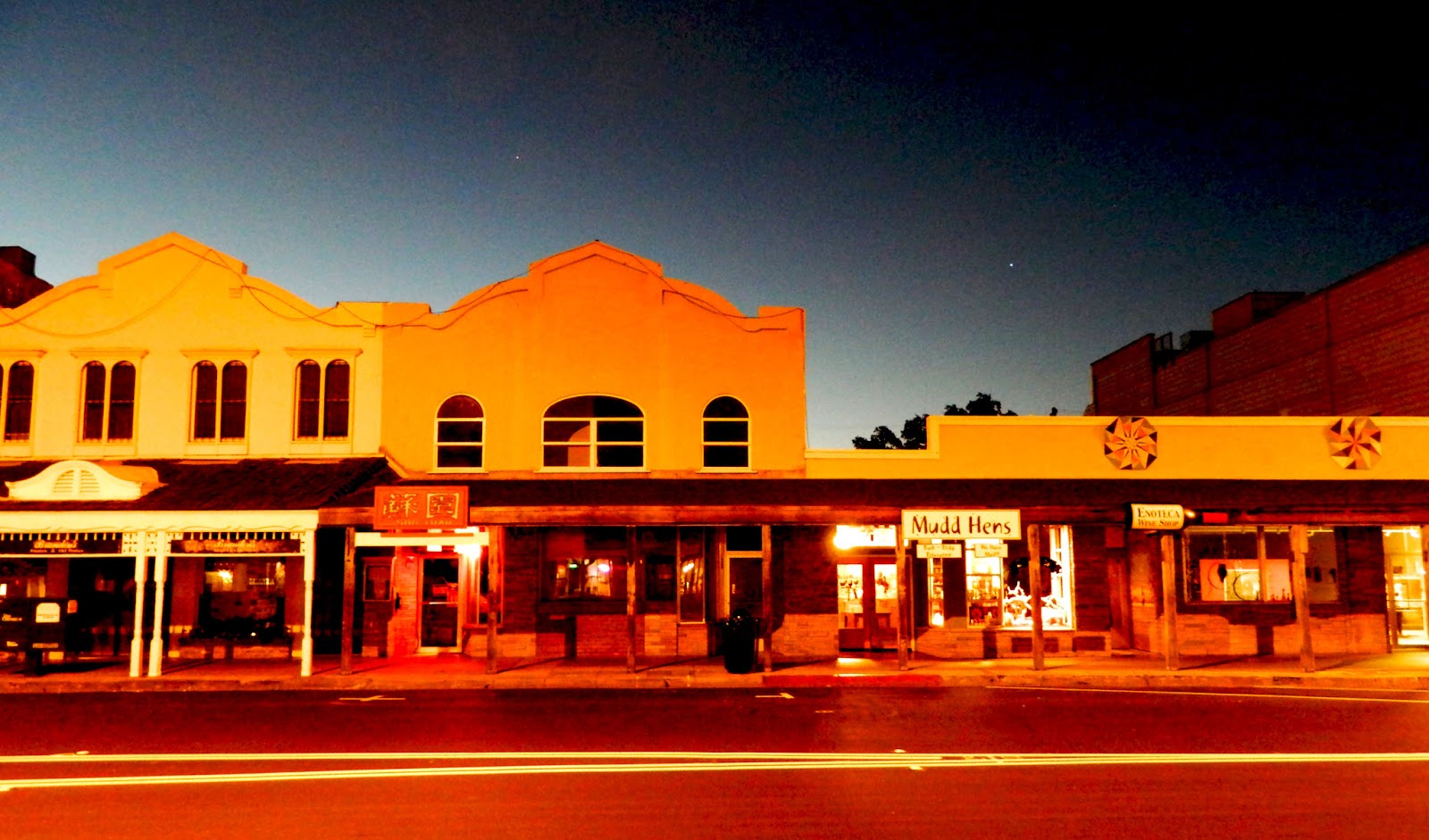
 We stayed in the northern Valley town of Calistoga, one of my favorite places in the world. It's not stuffy. It's not pretentious. There's only one main road through the middle of town, and I trull believe that it's not significantly different a place than it was ten, fifteen, maybe even thirty years ago. I wrote extensively about that visit on my blog entry THE GOOD LIFE, below.
The Napa Valley is a tremendous experience, provided, of course, you like wine and can appreciate the finer things in life. Good restaurants, excellent wines, spas, luxurious hotels (and a few not so much for us budget-minded folks) -- but generally an enjoyable time for adults who want something fun and delicious. If you're more into scenery and the sights, the Valley will keep you occupied for days. There's a significant difference, visually, between the south end and the north end. The west is significantly more populated and touristy than is the Silverado Trail on the eastern side. Driving is a major pleasure in this part of the world, though if you plan on visiting a few of the wineries make sure someone is the designated driver. No point in ruining a trip with an accident (or worse).
PACIFIC COAST HIGHWAY
 It's pretty much universally agreed -- among those who tend to agree and pontificate on such things -- that the drive along the Pacific Ocean between Monterey and Cambria is one of the most beautiful and unique drives in the world. The hundred miles or so of stunning seascapes, cliffs, forests and artsy little towns make for a spectacular few hours as you transit from one "ohmigod!" vista to another through areas well-known to connoisseurs of automotive commercials (your choice of sporty car of the month winding along the seacoast across serene and photogenic bridges). This section of the state deserves its reputation and is worthy of a trip in and of itself.
Our own visit came as we headed south again from the Napa Valley with friends, knowing that this would prove to be one of the more memorable experiences of their visit.
 |
| Monterey Bay at low tide |
The city of Monterey, at the north end of the drive, is a rich, beautiful seaside resort spot with a tourist-driven economy. Shops filled with tchotchkes dot its streets, and overly-priced restaurants offer beautiful views of the ocean. If you arrive with this as your expectation, the town can be a wonderful spot for a side trip -- a lot of fun, in fact. But if you arrive expecting to find the rustic and roughneck "Cannery Row" of John Steinbeck's novels you will be greatly disappointed.
At the other end is the far more charming community of Cambria, which still enjoys a bit of rustic rough edging though Moonstone Beach, the main hotel and seaside section of town, is greatly grown up. Fortunately the ocean side of the strip is protected from development, and thus maintains the beautiful views and largely unpolluted beaches the town is known for.
Heading south from Monterey where we found rolling hills that eventually spill off onto the edge of the ocean-hugging cliffs seen in the shots to the left. There are plenty of viewpoints, and we stopped at a number of them. There are a number of good places to eat, though we had already had lunch in Monterey before heading south. (If you're going to drive this section of the coast, be forewarned that gasoline is at a premium. Filling up in Monterey or Cambria will save you from getting royally gouged by the station operators who enjoy something of a monopoly in their section of the coast -- we payed roughly a dollar a gallon premium by forgetting to gas up.)
PORTLAND
It must be regarded as a singular state of failure (pun intended) for us never to have been to Portland -- or even Oregon -- before. Yes, there are still a handful of states I've never set foot in (outside the airport...this being a personal element to counting whether or not I can claim a state as "visited"). But Oregon is a relatively close one, and certainly has a fair share of things on my "to see" lists that it should have merited a visit long before now. Gladly, this is rectified.
The second half of our voyage with our friends from down under took us to downtown Portland for a few days to explore the city, as well as the surrounding areas (most explicitly the Willamette Valley and the Columbia River Gorge).

Downtown, we discovered, deserves all of the decades long tributes as being one of the truly fine cities in America. A vibrant downtown district that has a cosmopolitan and urban flair, while being just short distances from historic neighborhoods and dense forests. Oregon in general seems to have created a sometimes uneasy truce between urbanization and nature. Between technology and beauty.
The first thing that strikes you about Portland is that it's clean. Secondly, it's got a lot of trees. Thirdly, the people are friendly. (All three of these are surprises for anybody used to, say, Los Angeles. Or New York. Cities I love, but I have to recognize the difference in overall impact to the visitor.) Essentially, Portland is a smaller, more cohesive Seattle.
After a day in the city -- sufficient for a short bus tour of the highlights, followed by a walk along Water Front Park. (Okay, maybe they could use a little more imagination with the naming of things, but I digress.) We did a fair amount of shopping -- a.k.a. "Contributing to the local economy" -- and followed this up with a drive out of town down to the Willamette Valley for a couple of wine-tastings.
(Our friends from Australia are also wine lovers, and since one of my stated goals on my NOW list is to take a drink of wine in every major wine district in the world, Willamette needed to fit in somewhere on this stopover.)
The following day we bundled ourselves into the car and set off for a drive through the Columbia River Gorge, commonly described as one of the most beautiful natural settings in the northwest.
And I'm not going to dispute that the area is one of a great deal of natural wonder -- but the hand of Man has been unusually heavy in this otherwise pristine region. Maybe I'm just too used to going to area where humanity's impact on nature is not quite as profound, but while I had been expecting pristine vistas, I was often met with large reminders of the shipping which uses the river, and the Bonneville Dam which is a large gray scar in the middle of the gorge.
To their credit, however, Northwesterners do know how to overcome such things, and several of the feature did an excellent job of blending in with, and even enhancing, the natural wonders. Of particular note is the footbridge which leaps across your view directly in front of Multnomah Falls, a two-leap cascade off the high plateau on the south side of the river. As you can see on the photograph to the left, the bridge designer did a brilliant job of creating a structure which quite literally enhances the view of the falls, giving it both perspective and a sense of grandeur which might be missing if the bridge were not present. Likewise, Vista House, set high on a promontory surveying the central part of the Gorge, accents the views rather than distracting from them.
 But there's a strong line between structures which add to an environment and those which do not -- and as you can see in the shot to the right, there are large scars of highways and constructions which detract from the view of the Gorge.
(Don't get my criticism wrong, however, the Gorge is certainly worth the day trip, and the wonders outweigh the distractions -- my only issue were preset expectations, and for that it's entirely my error. I noted above the mistake of presetting expectation, but even now I still can do it upon occasion.)
MOUNT ST HELENS
A side trip during our drive from Portland to Seattle was a revisit (for us) to Mt St Helens, the volcanic mountain which exploded in 1980, destroying a good portion of the land surrounding the mountain. In the nearly eight years since our previous visit there has been some regrowth, but the area immediately surrounding the cone is still a ruined wasteland.
I've detailed my love of volcanoes, as well as previous visits to St helens elsewhere, but it was, and is, certainly a highlight of any trip in the area, and worthy of the hours-long detour to anyone who is simply passing by.
SEATTLE
With this visit, Seattle has moved up into what I would call our "middle group" of destinations. This is, by my count, the fifth time I've been to the Emerald City. Meaning that I am familiar enough with the layout to get around with no problem, and have a solid understanding of the activities and opportunities available.
On this particular trip we were still with our friends from Australia on our "Grand Tour" up the West Coast. Seattle was to be our final destination as a foursome -- ending with our delivery of our friends to a cruise ship so that they could continue up the coast to Alaska, the final leg of their years-long effort to tour the western edge of North America. (We first met them on a cruise to Mexico.)
 |
| Good place to eat after lurking Down Under |
Seattle, of course, offers quite a bit from cultural and historic standpoint, and we were determined to take advantage of this during our stay. This made for a rather hectic schedule, but we worked in a number of tours (the Seattle Underground and the Boeing plant in Redmond), as well as some classic Seattle touchstones such as the Experience Music Project and the recently opened Chihuly Garden and Glass exhibition at Seattle Center.
In my blog entry of September 9th, entitled "Lurking Around, Down Under" (get it? We were there with Australians, Get it?), I described the Bill Speidel's Seattle Underground Tour, a genuine way to really see and feel history from a hands-on perspective. As I noted in that column, it's a terrific, well run and well told tour that is worth the time and money to attend. Far from being a dusty old recitation of facts and figures, the tour operators have done a terrific job of detailing the achievements and failures of Seattle's early European settlers.
http://thumbnailtraveler.blogspot.com/2012/09/lurking-around-down-under.html
No visit to Seattle is complete without a walk through the Pike's Place Market. A literal hive of activity, it's an environment which is fun and entertaining -- though can be quite expensive if you're the shopping or cooking kind of person. Both sorts will find ample things to keep them occupied. The place, however, is worth a visit for just about anybody who enjoys the street scene -- and should not be missed by coffee lovers as it is the site of the original Starbuck's store (well, technically second location for the first shop). Or energetic busking amidst flying fish -- but...that's a story for another time.

Seattle Center continues to grow as a cultural destination. The site of the famous Seattle Space Needle is also home to a variety of museums and theaters, including Paul Allen's Experience Music Project. The EMP (and its relatively recent addition The Science Fiction Hall of Fame) is an interactive museum featuring exhibits and features from the history of rock and roll. Instruments from famous bands and legendary musicians are shown alongside performance videos, while in the more interactive rooms allow visitors to learn to play an instrument, or explore the thoughts and visions of people who have had a profound impact on popular culture.

Just across the plaza from the EMP is the new Chihuly Garden and Glass exhibit, which is one of the very best displays of its kind, anywhere.
Dale Chihuly is one of the premier glass sculptors in the world, and this exhibit shows the power of his vision in often spectacular fashion. An indoor and outdoor exhibition, the display ranges from a history of Chihuly's efforts through a whimsical undersea reef and out into a garden of glass-and-nature sculptures of a fantasy-like nature. The visuals are simply stunning, with each room opening to yet another "oh my God" moment. Highly recommended.
So, Seattle was the last of our stops on the Grand Tour, and the last of our big trips for the year. In December my buddy Jim and I raced up for a weekend to...
JOSHUA TREE NATIONAL PARK
I include a few shots from the park here, but seeing as my last entry focussed on the highlights of Joshua Tree, anything I could write would merely be redundant to what is below. Enjoy the pics on the just-below blog entry.
So I offer a little toast to 2012. A year that was reputed to end in Apocalyptic catastrophe, but is satisfied instead settling for a fast run full of vivid memories.
See you in 2013.