About Me

My photo
Welcome to the online blog for traveler/writer/photographer Steven Barber. Come in. Relax. Take off your shoes and socks -- or any other article of clothing, this is the internet. Have a look around. I hope to intrigue, amuse, entertain, and maybe provoke you just a little. I love to find adventure. All I need is a change of clothes, my Nikon, an open mind and a strong cup of coffee.

Saturday, December 22, 2012

"Joshua Tree, Ve-ry Pretty"


"A desert is a place without expectation" - Nadine Gordimer


Where no Honda has gone before...
It's interesting -- at least to me -- how things change as we grow older. As a teenager and young adult, I used to proudly proclaim that anything "outside a million metro population" made me nervous. It was my way of looking down my nose at small towns and, in particular, the desert. Small towns in the desert most specifically. 

This was largely, and unfortunately, due to the fact that my maternal grandparents lived well out into the desert outside of a town called Apple Valley. At the time it was a spot many miles off the beaten path, and this was an era before things like satellite and cable brought the world to our doorsteps. So, for me, a visit to my grandparents' house was often a lesson in a typical kid's boredom of "nothing to do". (And, being the imaginative kid that I was, the desert also represented a lot of scary things -- I had, at this point, seen enough old 1950s horror films, and more than a handful of episodes of The Twilight Zones and The Outer Limits (in which scary things lurked in the desert) to be more than just a bit nervous at things that went bump in the night. For some reason undoubtedly explainable by an electrical engineer, the only channel that came in even reasonably clearly was the one broadcasting reruns of those shows, reinforcing the desert's aura even that much more. 

Jim goes exploring
Things that go bump...

If you were to visit the old "Circle K Ranch" these days, you would wonder at it ever being remote. The city has, unfortunately, grown up around it, making the home's isolation a thing of the past. And at the same time, I too have grown in the opposite direction, finding an amazing and majestic beauty in the remote regions of the desert. I find the stark, unadorned landscape to be, in its own way, as beautiful as lush forests or dramatic seascapes -- while at the same time at a more rugged and spectacular scale than virtually any other setting. (If there are no trees, they do not block your view of the forest.)

Perhaps it's a result of ever-increasing pressure at my day job that makes the open isolation appealing to me. The desert affords a true getaway, a true escape from the workaday world. If your cellphone doesn't work, you have to just sit back and accept it. Railing against the lack of dial tone does little more than echo off the granite walls, or dissipate amongst the desert sage. There is a quiet serenity there. A lack of sound, even wind through the brush at times. How often are we in a wide open area with virtual silence as a companion. Not often, and not often enough. 

(Craig Fucile, one of the very best nature photographers in the Western U.S., once told me that the desert was one of his favorite places. And for good reason, as I now know. The night shot top right is a deliberate attempt to echo some of Craig's wonderful time-exposures of the Death Valley. I wish I had a website to refer you to. His work is outstanding, and he's one of the nicest people you'll ever meet.)

As usual, I digress.

This last weekend I took a weekend and went up to the Joshua Tree National Park with my desert travel buddy Jim, mentally convinced I'd never been there before. 

As Jim and I drove the roads and pathways of the park, however, something struck me as familiar, and not because other areas of the California desert look similarly -- quite the opposite, in fact. 

For years I have been trying to summon an idea of where I once hiked when I was a member of a local Boy Scout troop. The adult who headed our group was fond of the outdoors, and we would, on a regular basis, trek up into the Angeles Crest mountains or The San Bernardino Mountains, or, well, you get the point. 

But there was one very particular overnighter we took one long weekend which was through the middle of the desert. It was -- or must have been -- wintertime. I explicitly remember the night being particularly cold, both in our sleeping bags as well as in the army transports which the leader had managed to conjure for the trip to and from the desert.

It's this latter which gives me the biggest clue that I may have already been to Joshua Tree. You see, not only is the terrain quite vividly reminiscent in my memory, but the military transports -- such as those which would be used by the Marines at TwentyNine Palms Marine Base (directly north of Joshua Tree National Park). Given those two elements, it's entirely possible our troop leader took us on a hike through one of the many remote areas of the park. (There is even one trail marked as "Boy Scout Trail" -- so the clues are certainly lining up!). I am convinced, just shy of certainty, that Joshua Tree or something nearby, was the setting for that particular scout trip.

All that, of course, is prologue to this entry's photographs.

A trek into the isolated desert, for me, is a short duration thing. I have yet to venture up for more than a couple of days at any given time, and this does two things for me. First, I tend to be a reactive photographer. That is to say, I am sensitive to the surroundings and find my subjects rather than planning ahead for them. Some photographers will predetermine what they're going to shoot, and under what conditions. It works for them, but my eye is one which wanders around the landscape to pick what most interests me from a compositional standpoint. This is true whether I'm shooting in the desert or downtown Manhattan. For me the ideal is to go walkabout (driveabout in some cases) and let my eye fall on my next subject -- THEN I will determine how to shoot it and the intent behind the shot. 

In that regard, I'm a spontaneous photographer, which for some professionals in the field is a fault. I consider it an asset. Thus endeth the "Methodologies" seminar. (My blog, my rules.)

So please enjoy this short trip to Joshua Tree, and as always, thanks again for coming along to Share the Adventure


Welcome to Bedrock


(One final thing - I always love to visit local restaurants when I'm on the road, particularly those with terrific breakfasts. If you're in the town of Joshua Tree, or simply going through it to get to the park's main entrance, I highly recommend The Country Kitchen, which is near the corner of Highway 62 and Park Blouevard. Excellent food and a real homey cafe feel. Nothing fancy, just a "good eats" sort of place.)


Tuesday, December 18, 2012

High Times


John Muir 
 

I have for years advocated the idea that the best way to get people to understand one another and understand their place in this universe is to get them out of their normal frame of reference. I travel to learn about other places, other people and other cultures -- getting out and away from the familiar and exploring the options of a place different from my own. It is beyond me why someone would travel all the way to New York City, Times Square, only to eat at The Olive Garden or Bubba Gump. There are fabulous delis and restaurants just across the street from these establishments, and yet the lines continually range to an hour or so wait.

So much of my thinking when it comes to a trip is seeing the new stuff, the unique stuff. And the best place to see that stuff is usually from well above, looking down and gaining a humbling perspective on our world. If you want a feel for New York City's vast scale, look down upon it from the Empire State Building, or 30 Rock. Toronto has its CN Tower. Paris has the Eiffel Tower. Despite an annoying recurrence of acrophobia, I've ascended these and many other towers and buildings to gaze down upon the cities below. But when it comes to views of the world, there's nothing like the summit of a mountain to give you a true feeling of the scale of mother nature, and the small size of man in relativity. I've been fortunate to stand on the edge of the Grand Canyon. I've looked out over the vastness of Mount Etna in Southern Sicily from the edge of the town of Taormina, itself perched atop a spectacular cliff over the Mediterranean Sea. I've seen the lush landscapes of Virginia from atop Skyline Drive through the Shenandoah National Park. And the Rocky Mountains from Deer Ridge. 

It occurred to me recently that 2012 has been a terrific year for my own "perspectives from above". Below are five different places with stunning landscapes of their part of the world. Each has a well-deserved reputation for beauty, as well as a vista that is difficult to duplicate nearly anywhere else in the world -- in other words, unique. The phrase "looking down on" is usually reserved for a dismissiveness or a kind of arrogant egoboost -- but in this case, the phrase means "gaining perspective" -- because looking down at these natural wonders will certainly put you in mind of truly how humble we should be in the face of creation.


JOSHUA TREE NATIONAL PARK - Southern California

This last weekend I was on a short trip up to the Joshua Tree National Park, which is one of the most amazingly special places on Earth. Driving through sections of it are as close as we can get to traveling on another world. The images, the vistas, are so unlike anyplace else you've been that it almost defies description. It's as if you've gone through a temporal hole and found yourself in Bedrock, the stone city of Fred and Wilma Flintstone -- in fact, the rock formations almost look like a setpiece from the 1994 movie (I don't believe they are, but they have that distinct look of a man-made object fabricated from rocks).

Despite a smooth road and ample facilities, a little-visited section of the park is at the summit of one of the peaks overlooking the Morongo Valley. The area is called Keys View, a remarkably modest name for what is, in fact, a spectacular overlook with a view looking down upon a long valley stretching southeast to northwest through the California desert. You cannot see it in this shot, but far to the left down the valley is the Salton Sea, an inland lake easily seen on any map of the state. Directly across from Keys View is the city of Palm Springs and its varied suburbs. So small it's invisible here, tucked back against the base of the mountains on the far side of this shot. The tallest peak, Mt San Jacinto, is ten thousand feet in height. The dark line of hills running through the middle of the valley is a surface manifestation of the dreaded San Andreas Fault -- the hills were thrust up as a result of the two tectonic plates running parallel to each other and forcing the rocks between the two upward to relive the pressure below ground.


MOUNT SAINT HELENS - Southwestern Washington State

Volcanos fascinate me. I've visited Mount St Helens twice now, and the scale of the mountain (and devastation) astound me. When you are standing on at the Johnston Ridge Observation Center, a beautiful vantage point made notorious when, at the onset of the mountain's 1980 eruption, volcanologist David Johnston radioed the chilling words "Vancouver, Vancouver, this is it". Johnston died seconds later as the full blast of the event annihilated the viewpoint. The eruption is one virtually everyone has had seared into their memories. 

The experience of standing in generally the same spot of David Johnston, looking out over a once-green and forested valley which, even three decades later, is a barren desert. The annual rainfall has carved deep channels into the side of the mountain, through the soil thrown down by the volcano's lateral (sideways) blast. A massive landslide, viewable in several videos available to watch at the Visitors' Center right behind you, literally covered the valley below as the entire north flank of the mountain collapsed. The scale is staggering, and a good part of your visit will probably be spent trying to understand the true scope of the scene before you. Our minds just aren't used to thinking of events of this size, so we're tempted to reduce it to a more comprehensible scale.

But, true to its nature, St Helens isn't satisfied to be thought of in our perspective, she requires us to open our minds and deal with her on her own scale.


 THE COLUMBIA RIVER GORGE - Border zone between Washington State and Oregon

Like the other locations in this essay, The Columbia River Gorge has a well-deserved reputation for natural beauty. Multnomah Falls is one of the most picturesque falls in the country, and, oddly enough, the man-made bridge which straddles the cliffs directly in front of the falls adds to the beauty of the scene instead of detracting. That's a very rare occurrence in this world. Normally man's creations mar the scenery, revoking the pristine and raw beauty of nature. Likewise the Vista House, pictured left against the central part of the gorge. It seems to have a well integrated beauty of its own, with a care taken to ensure that despite the indisputable presence of the building. Like the Grand Canyon, care seems to have been taken to ensure that the presence of man doesn't detract from the natural wonder. 

Unfortunately, this cannot be said for the Bonneville Lock and Dam, a giant project which, though necessary for the region's power generation, is a scar across the middle of the gorge. Also unlike the other viewpoints I'm discussing here, the presence of mankind in the gorge is easily and constantly visible, from the dam, to the tankers and freighters traversing the river, to the highway running up the southern shore, the gorge cannot be considered pristine or fully natural, and perhaps its because of the extreme beauty with which it started, the scars inflicted upon it by mankind might diminish but cannot destroy its impact on the eye.


THE PACIFIC COAST HIGHWAY - Central California coast

The central California coast is one of the most spectacular drives in the world, rivaling scenery from around the world for raw beauty and ruggedness. Despite its residence in the most populated state in the Union, the Pacific Coast Highway's journey from Carmel to Cambria is one of stunning overlooks, cute towns, tall forests and seaside flatlands all in the range of a hundred miles. There are few places in this world with this kind of a combination landscape, but without a doubt the premiere views come from the seaside cliffs as you drive the winding road along a narrowly cut notch is the side of the mountain. The Pacific Ocean thunders against the base of the cliff, and the road meanders from hundreds of feet up in some sections, to barely skating above the rocks in others. Along the way there are multiple stopping points to get out, stretch your legs, and marvel at the majestic sights all around.


MOUNT HALEAKALA - Maui, Hawaii

Sunrise atop Mt Haleakala is one of those things that once done stays with you for the rest of your days. The gradual glow appearing in the east. The initial tic of gold, brilliant and bright, along the cloud's edge on the horizon. The absolute grandeur of light as it touches the volcano's valley, which until moments after sunrise has been nothing more than an inky darkness on the far side of the cold metal bar railing. As the sun rises you feel its warmth on your skin, a welcome relief from the cill night air. You're in Hawaii, but you're also at 9,500 feet where the air is cold and thin. Behind you gather perhaps a hundred other pilgrims to this, one of the world's most beautiful moments. Off to one side a singer begins the customary native Hawaiian chant to welcome the new day, adding to the ambiance and authenticity. For an instant you are transported back to Hawaii as it was hundreds of years in the past. Haleakala means "House of the Sun" , and it is easy to see why they felt this way. There is a newness, a pristine beauty and moment when the world itself seems to stop, hold its breath and finally give way to the new day.


The View from Above

Saturday, December 15, 2012

Movin' Out

I may not have gone where I intended to go, but I think I have ended up where I intended to be. - Douglas Adams 


Just a quick jump-in to note that I'm off for a two day photo shoot in the Joshua Tree National Park. Never been there, though I've skirted it any number of times. The rock formations are reported to be stunning. If the weather improves (it's apparently rainy out there as I write) I plan on getting some night-sky shots of the desert. I will certainly be posting those here.

O-Dark Thirty
I may be a bit over-packed. I had planned on taking my trusty old film camera, a Nikon N6006, in the trip for the time exposure -- film is still inherently a better medium for such things -- but cannot find it. Most frustrating, and an indication I need to store my equipment better than it is now. (Most of the time it's securely in my camera bags. The largest bag, a backpack really, contains camera bodies, lenses and photo cards. The other has electric cords, recharges, etc. ) 

My photo gear outweighs my over night bag some fourfold. Fortunately it's a road trip, not a flight. Perhaps at some point in the future I might do an essay on equipment and transportation -- it's not a pretty picture in many cases (no pun intended). The backpack has traveled extensively. It's a neat way to keep the most valuable and fragile equipment safe, though a lot of photographers prefer the heavy duty metal bins for shipping the gear long distances. That tends to be more of a burden at the other end for me. I prefer being more mobile, but certainly understand it when you're dealing with a larger production, more equipment or heavier gear.

Watch the Twitter feed (@Thumbnailtravel) and the Facebook page for updates for the next couple of days. I'll try to be diligent, though if it's still raining the reports might be of a decidedly wet nature.

Catch you on the flip-side!


On the Road Again!


Sunday, December 9, 2012

A Moment in Time


Here we are. At the end of 2012 , looking to the new year with anticipation and hoping for the potential it has to make those bad things right and those right things permanent. It has become an almost ritualized time of optimism that coincides with a number of religious and secular celebrations of miracles and mankind.

It's also a time of reflection. Looking back at the last year, and perhaps further dependent upon your personal lot in life. In the week between Christmas and the New Year I'll be posting a look back at the last year in travel -- those places we've been and the experiences we've had on the road. A fair amount of territory, both familiar and new, was covered this year, though in a more concentrated geography than the preceding couple of years.

And plans are afoot for a fascinating series of trips next year. 2013 is shaping up to be quite active with three fairly solid trips already taking form.

Below are a handful of photos I've taken while on the road. Nothing in the last few years, but these tell stories to me if to nobody else, so I'm going to indulge in a little bit of looking backward at moments that hold a lot of meaning to me personally. That's the value, in my opinion, of photography. Each shot should tell a story, and preserve an instant of time. In time. And, as I note in my artist's statement at barbergallery.net:

"Much of the challenge (and pleasure) of photography is to give a sense of place. While the photographer may have concrete memories of a moment he/she has captured in time, the viewer does not. 

What has to occur for the viewer to appreciate a photograph is the triggering of a memory, thought or emotion. 

For a picture to be truly successful it must be visceral, capturing the essence of what the photographer saw, and melding it to a feeling the viewer once felt. 

I am drawn to take a picture as a result of a fraction-of-a-second emotional reaction. If I see something that attracts my eye it must, in that fraction, catch me and then tell me a story. 

For me to later select that picture -- among the potentially hundreds of others I have taken -- as one which I wish to share, it has to have a little something extra, a little something that brings me up short, makes me stop and look. 

And look again."


49th Street Station - New York City, 2010

I happened to be on walkabout late one night while in Manhattan. The activity level of the city was just beginning to die down on the side streets, though still in full gear along the main boulevards. As I was walking I happened to see this gentleman sitting on a stoop grabbing a smoke. It's a quiet moment in the midst of a busy Saturday night. Who is he? Is he just off the train or just before boarding? Does he work at a local business? Doing what? My mind conjures a number of responses, but for now he's simply a loner sitting on a step with his cigarette, lost in thought. 


Nothing But a Blur - New Orleans, 2006

Taken less than six months after Hurricane Katrina devastated the Crescent City, this captures my attention. Most of us have had those evenings when we over-indulged. It's not a pleasant memory, if indeed we can even remember it. But in this shot I see a moment in time we (mostly) can share. When the battle cry was "one more shot", at a time when our bodies could handle those things. (Is it that my tolerance for alcohol has decreased over the years, or my tolerance for hangovers? Regardless, it's had the same effect.) For anyone who has had one of those "nothing but a blur" evenings, I hope you can relate. (I have added a good bit of grain to this shot to add a bit of a dreamlike texture, adding to the "blur" of the title.)


In Shadows - Palos Verdes Peninsula, 2001

The afternoon sun can give you harsh shadows and deep silhouettes. Rather than fighting it I tend to like to play with that lighting, using the sun to bracket a subject and let that tell me more that a close up or differently lit angle might have conveyed. In this case, a boy was riding his bicycle along the sidewalk in a park abutting the cliffs along the southern edge of the Palos Verdes Peninsula. There is a beautiful lighthouse in this particular park, so I was spending some time finding different angles and trying to create a mood -- this was taken before I'd made the full transition to digital, so each shot was a more labor-intensive effort than it would be today. The boy hopped off his bike to ask me what I was taking a picture of. I told him, and then asked if I could take his picture with his bike (a decade later this sort of thing might get me arrested.) He said yes, and this is the result. I like the body language and silhouette against the bright sidewalk. It might be a short story, but a story nonetheless. (Post-work includes a watercolor filter, so the image has more of a painted quality.)


Lap of Luxury - Boulder, Colorado, 2005

Springtime in Boulder is a beautiful time. The town nestles itself against the eastern edge of the Rockies, in a low valley between mountain and prairie. It's a quiet college town that prides itself on its colorful history, with a bohemian vibe out of step with the rest of the state. The most commonly seen car, I think, is a Subaru, indicative of the population's love of the outdoors. The mountains are a playground for Boulder-ites. Hiking, skiing, rock-climbing. Boulder is an energetic city, comfortable in its own skin and seemingly independent of the rest of the world. Even the homeless seem to be more at ease...


Two Sisters - Capala, Mexico, 2008 

I was on a trip through the foothills of the Sierra Madre. A brief but intense storm had brushed through the town of Copala, knocking out the power. In a lesson for stateside eateries, the restaurant in town -- an open-air patio overlooking the mountains -- fed a tour group of some forty people without an erg of electricity. The only challenge was navigating the pitch-dark restrooms if nature called. Once we finished with the meal, a wonderful repast of shredded pork on house-made tortillas, locally grown vegetables and a wonderful dip with the consistency of hummus but the flavors of Mexico, we wandered down the road a bit to see some of the local sights. (The rather unfortunate photo of the gaudily dressed tourist atop a small donkey -- used in a couple of previous blog entries -- was made at this same time.) Looking down the side streets, I chanced upon these young girls making their way somewhere, their cheery and bright outfits in contrast to the rust-colored wetness of the roadway, a self-contained world with a population of two.


Tears on the Sands - Santa Barbara, 2008 (below)

This shot is a little misleading, I will admit. I don't believe the two people in the picture are actually interacting with each other. I was out with my cameras early on a particularly bleak and gray day, frustrated at the lighting in a city renowned for its sunshine. As I was working to salvage what had, up to that point, been a series of dark and muddy shots of the pier and State Street, I happened to see these people on the beach. Using a long range telephoto I managed to capture what appears to be a moment of anger on the part of the woman in the foreground, and contrition in the silhouetted man in the background. Part of this was accomplished in post, reducing him to nothing but a shadows, while she stands in stark relief against the beach. It's a case of seeing an event and capturing it, and then finding the story it tells you, rather than what might actually have been occuring. 


Monday, December 3, 2012

ROAD TRIP: Under the Tuscan Sun shooting locations


“Whatever a guidebook says, whether or not you leave somewhere with a sense of the place is entirely a matter of smell and instinct.” 
― Frances MayesUnder the Tuscan Sun


We all tend to travel with preconceived notions of what a particular destination might look, smell and be like. Usually we're wrong.

These images are often fed, and in fact created, through the entertainment industry. Television programs such as THE AMAZING RACE, NO RESERVATIONS and THE BEST OF… are travelogues which are designed to give us a taste of a particular place -- but are more akin to what in the restaurant industry is called an amuse bouche -- a single, bite sized appetizer rather than a full blown meal. In other cases, and as I've mentioned in many a previous column, films are an excellent source of inspiration. But since most films are trying to tell a story, it's rare that a locale is such an integral part of the story that the film compels us to seek out a place and explore it further.

UNDER THE TUSCAN SUN is one such film.

(Okay, okay, I can see all the guys reading this rolling their eyes and muttering "but that's a chick flick" under their breath -- or, standing on their desk screaming it at the screen. You know who you are -- and it is. No question. Like every married man I find myself periodically in a theater watching such things, and I'll admit there are moments where I wonder what the heck I am doing. On the other hand, my wife also happily accompanies me to James Bond films, so there's little room for complaint. And certain chick flicks do an outstanding job of conveying the essence of a place to the extent the location becomes much more than a setting, it becomes a member of the cast. And again, UNDER THE TUSCAN SUN is an example of this.)


For those of you who might not have glimpsed this particular film (guys, shame on you. At the very least it has the ever-watchable Diane Lane in your eyesight for a couple of hours, which is hardly a bad way to spend an afternoon. And it features two different Italian towns in starring roles which ultimately encouraged my wife and I to visit them on our first trip to the Italian peninsula.

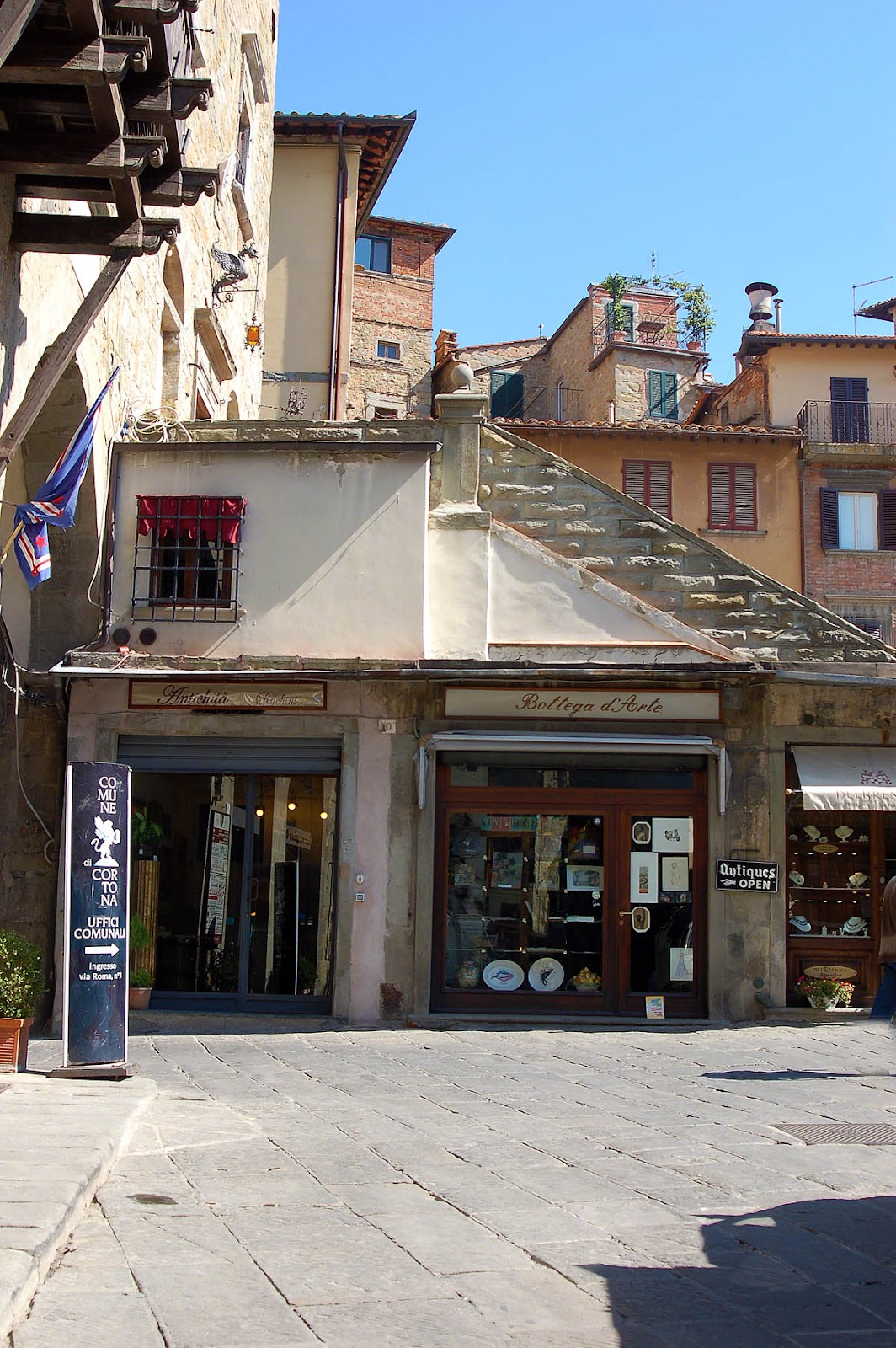
The first of these towns, the one which inspired the title of both the book upon which the movie is based and the film itself -- the town under the Tuscan sun -- is Cortona, a beautiful hilltop town along the southeastern edge of Tuscany. From the rotary parking area at the southern edge of town you can stop and look out across a literally stunning landscape of towns and farms, with hills and lakes in the distance. As much as anywhere in this part of Italy, this is truly a view worth traveling for. Plus, once you're done marveling at the beauty of Tuscany, you can retreat into the heart of Cortona along its main market street -- a walking avenue of restaurants, boutiques, shops and alleyways that lead the shopper to the central Cortonese square(s) (there are, in fact, two adjacent squares which make up the center of town.) Much of the movie was filmed in this central plaza, and if you're familiar enough with it you'll recognize the wide stone stairway that is featured in several scenes. (Don't be too disappointed that the fountain which plays an important role in the movie is absent. Evidently it was brought inky the film crew specifically to anchor the Fellini scene. It doesn't really exist, though it should.)


The second destination featured in the film is certainly worthy of the two hour drive south of Rome is the Amalfi Coast town of Positano, which clings as a man-made cascade down a seaside cliff along the edge of the Tyrrhenian Sea. 

In the film TUSCAN SUN (UTTS for short?), Positano is shown to be a seaside paradise of simple family dinners along the beach. In truth, it's somewhere between that and a sophisticated, modern tourist and travel mecca, with elegant shops and boutiques lining a wisteria-drenched alley winding its way up through the heart of the town. Along the waterfront are a number of cafes, along with a vibrant artistic trade -- both in shop on along the streets. 

Perhaps in the off-season it quiets down and is truly the family-oriented seaside retreat depicted in the movie, but during tourist months it's a bit more crowded and noisy, though still every bit a special destination for the discerning traveler.