About Me

My photo
Welcome to the online blog for traveler/writer/photographer Steven Barber. Come in. Relax. Take off your shoes and socks -- or any other article of clothing, this is the internet. Have a look around. I hope to intrigue, amuse, entertain, and maybe provoke you just a little. I love to find adventure. All I need is a change of clothes, my Nikon, an open mind and a strong cup of coffee.
Showing posts with label Holland America. Show all posts

Monday, January 25, 2016

ROAD TRIP: Antigua, Guatemala


Guatemala

Breakfast in the Rotterdam dining room aboard Holland America's Veendam. We elect to eat there given the later departure of our tour (11am) as well as the overall quality of the food served there.

Palacio del Ayuntamiento
Departure from ship promptly at 11 on one of some six busses headed up over the foothills to the inland UNESCO Heritage city of Antigua, one of the most historic cities in Central America. The scene is chaotic until we're actually aboard our bus. The rest of our party is told to load onto a separate one, and we rendezvous again once we reach Antigua. 

Driver is Alex. Guide is Ferrrrnando, with a deliberate (and tongue in cheek) trilling of the Rs. His commentary on the way is interesting and informative, relating both the ancient MesoAmerican importance of Guatemala, as well as more recent history including the causes and impact of the country's relatively recent civil war. He assures us as we made our way inland, that Guatemalans are moving on and looking towards the future.

It's a beautiful drive, first through the flat lowlands abutting the Pacific then low hills and up into the Sierra Madre proper. Unfortunately the day is hazy with low lying clouds preventing us from seeing the summits of any of the volcanoes surrounding the historic cities of Viejo Ciudad and Antigua. 


Volcan de Agua
(We find out later, a good portion of the haze was what is called "vog". Common on Hawaii's Big Island, vog is short for volcanic fog, a combination of natural cloud cover/fog and the smoke from an active volcano...in this case Volcan de Fuego: Volcano of Fire. It was dense, obscuring the tops of the three volcanos surrounding Antigua, though the sharply rising bases of the mountains gave a sense of scale and power.)

As we arrive in town, I am astounded at Alex's skill in maneuvering the full-sized tourist bus through the tight streets and intersections of old town Antigua. He deftly passes signs and other vehicles with at-times only inches to spare. I worry at one point when he comes nose to nose with an aggressive three wheel taxi, but Alex backs off and allows the taxi to pass rather than squashing it like a bug on the bus' front grill.

We disembark at the Jade Museum and store just after 12:30. Fernando tells us we need to be back at the same spot by 4pm for the return to the ship, which gives us roughly three and a half hours to explore the town. With six people in our group we do the customary milling about for a few moments before deciding on a direction. We turn right on Calle Quartero (4th Street) and head west for the Plaza Central.

Two things will immediately catch your attention in your first few minutes in Antigua. One is the architecture, a beautiful and old worldly classicism which evokes the city's history in a real and tactile fashion. 

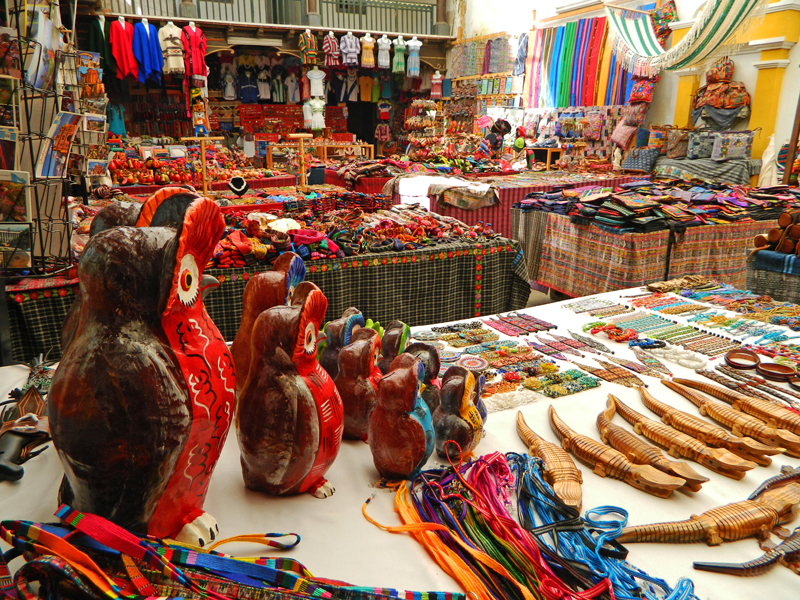
The second is he constant assault of street merchants who aggressively want to sell you tchotchkes, toys, fake jade, fabrics or jewelry, often in combinations of all the above. It's an unavoidable aspect of your visit, and you become accustomed to the constant need to firmly say no, though that deters only about half of the people who are mostly women and who will continue to offer you their wares, tailing you down the streets as they do so.

But the true character of Antigua is found, as in many Latin American cities, behind the walls of the buildings. Entering shops, restaurants or exhibits you find beautiful courtyards, serene retreats from the maddening din of the street. Here you can pause, wander about and shop, eat or drink coffee in a quiet and friendly environment.
We found such courtyards at the Antigua Gallery of Art, The Museo Choco, and several other spots along our walk.


The Central Plaza is, plainly speaking, a madhouse -- or at least was on the day we visited the town. We were there on a Saturday, which might explain the chaos, and found the park at the middle of the plaza was chock full of tourists, local visitors, the omnipresent street hawkers, and children playing. The only real reason to visit the Plaza is to see some of the astounding and historic architecture of the buildings lining the outer edge, and we found that it is best to spend your time on the side streets instead of in the main square.

Arco de Santa Catalina
Inside the Mercado
One of the necessary viewings in the city is the famous Arco de Santa Catalina which nicely frames the street and surrounding buildings, a bit of history kept in good repair by the five star hotel which now occupies the facilities. A walk up Calle del Arco is a pleasant and representative experience, and if you have limited time in the city it's the one thing I'd most strongly recommend. We shopped at one of the little mercados, buying several items -- table runner, large fabric bag and other things -- at reasonable prices.

Mime's the word
Dodging the street hawkers and a very popular street mime (who attracted a sizable crowd), we ducked into the Bistrot Bourbon for a quick lunch of paninis, beer, and what is my official Guatemalan Martini. Intriguingly enough the martini was a mixture of Stoli vodka with Cinzano vermouth -- a combination I'm certainly going to investigate further upon my return home.

Antigua strikes me as an historic adventure worthy of a visit, but the traveler needs to be aware of the continual assault from the hawkers, some very aggressive, and the crowded nature of weekends in the city. Otherwise it's a place with a lot to offer, and any student of Guatemalan history will certainly want to have a look at one very important center.

Must sees: 
Ruins of La Iglesia Concepcion Convento 
Catedral de San Jose
Walk up Calle del Arco
Lake Atitlan


Guatemala is a beautiful country, and the people warm and inviting. We were unable to get to several areas which merit discovery (Tikal, Lake Atitlan, the Caribbean coast), and are saving them for a future visit. 

As we return to the ship, Guide Fernando conveys the heartfelt belief that Guatemala's message to the world is "Yes, we know we had problems, but we're better now. Please come back, we have a lot to share."

It would seem to be a good idea.


Catedral de San Jose


Friday, January 22, 2016

ROAD TRIP Puerto Vallarta


Puerto Vallarta

The morning began quite early for us. 5:30am, adjusted eastward two hours since our departure from San Diego. We showered and got ourselves ready for the day. Breakfast delivered a few minutes before the scheduled 6-6:30 window. Fortunately for room service I had donned my clothes before hearing the porter's soft knock at the door.

Martha's ready to go!
We departed the stateroom promptly at 7:05 and were pretty much the first people checking in with our guide on the dock. Martha, the very energetic and friendly tour guide from Vallarta Adventures, was trying to corral twenty two visitors headed into the Sierra Madre for what was (accurately) billed as an off road "Eco-Safari". Despite the promise of a rather rough ride and a three-quarter hour guided Eco-walk through the rainforest, the majority of patrons were several years our senior. The only younger participants were the tour employees and one of the ship's photographers sent along to document the adventure.

Dockside we were transferred into a small shuttle bus, which carried us a mile or so up the road for a rendezvous with the two Unimog military vehicles which would be our rides for the excursion. We piled in to the open air rear cargo/seating area and set off up the highway, immediately discovering that a) warm jackets were indeed a necessity, and b) any attempt at styling one's hair for the day was a completely wasted effort.

We shortly arrived at the town of Bruceria. 20 kilometers (12 miles) northwest along the coast from Puerto Vallarta. Turning inland, we followed a dry riverbed which became consistently less dry the further into the mountains we drove. The makeshift roadway carried us up into the Sierra Madre, dodging the occasional wandering cow, dog or other driver until we arrived at a  locked gate, demarking public land from a private reserve. The riverbed became a very rough "road" from that point onward, but the terrain wasn't much of an obstacle for our driver or the Unimog. In fact, it should be noted that the driver would later slow down more significantly for speed bumps in a town than he did for the rocks in the riverbed's irregular terrain.

Martha takes charge!
Not that I'm complaining. It was a great deal of fun, though a few of the older members of our little Familia (as Martha labeled us) might not have been quite so enthusiastic about it. Pulling oneself up into the Unimog isn't a strain, particularly for travelers with canes. No overt complaints, though a few grumbles from the more fashionable travelers in our midst. 

Arriving at our first stop, the unimogs were backed into a side grotto, and we all disembarked for a moderate walk through the forest. Martha and Adrian, her partner/guide from the other vehicle, took turns explaining this part of the Sierra Madre's biosphere as we came along them, identifying dangerous plants to avoid, beneficial ones and the services they could provide, as well as a few small members of the forests fauna -- a large termite nest and several examples of the native ant species. The larger animals and bird species kept their distance, though we heard periodic vocalization examples of both in the distance.

Clambering back into the Unimogs the two-vehicle convoy set off back down the riverbed again in search of "Sarita's house". Within a few very fast-paced minutes as we raced across the rough terrain, slowing just once to ford a pile of rocks and sand that was daunting even for our military-grade transportation. I quickly labeled it a speed bump, which elicited an ironic laugh from my fellow passengers.

Sarita's house in fact was located in a compound located twenty or so
Sarita
 feet above the riverbed on a natural hillock, across the way from a forty foot cliff face at a bend in the river. The two vehicles clawed their way up the  steep driveway -- dirt path, really -- and parked off to one side. There were four structures, with the house situated at the rear. A wood shed to fuel the large open air save and frying pan was off to the left, and to the right was a wood structure with a roof and open walls. Sarita was already hard at work at the oven, patting down homemade corn tortillas, flattening them on a press and slapping them down on the pan to heat up. Off to one side were an assortment of beans, avocado and rice for the tacos, as well as a sampling of local peppers to be tried at your own risk. Several of the group tried their hand at molding and flattening a tortilla, to various results. Sarita generously told everyone how well they did, regardless of actual performance.

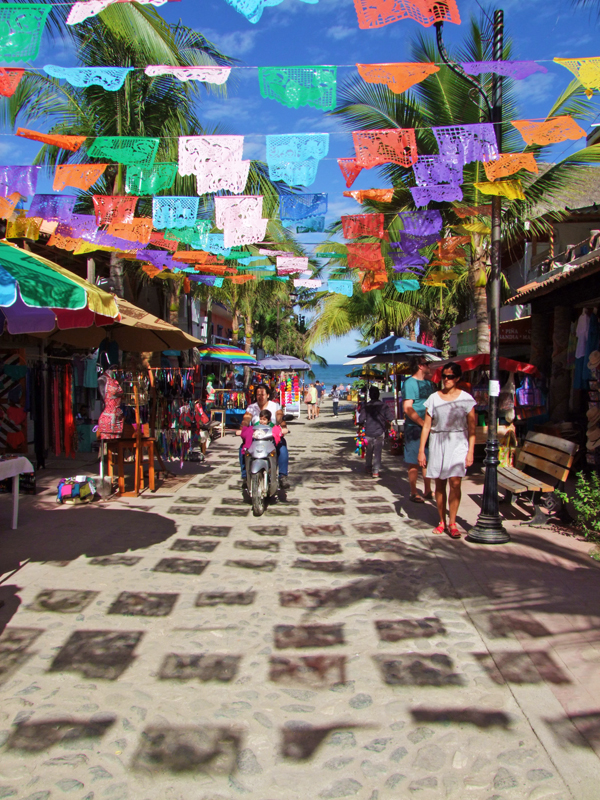
After a brief and very pleasant visit we were off again, regaining asphalt after a ten minute drive down the remainder of the riverbed, slowly morphing itself into first a dirt road then an actual paved road towards the center of Bruceria, turning onto a larger highway for a smoother trip further up the coast and across the foothills to the picturesque seaside town of Sayurita. Echoing the more traditional city centers with its streets of shops, bars and vendors running down to a colorful and crowded main beach, Sayulita was a welcome stop enabling us to climb out of the Unimogs and wander aimlessly for a time before we again clamber up and head off for lunch at isolated beach over the coastal foothills from town. 

Sayulita


Martha serves lunch
Lunch was served on a beautiful seaside events building, overlooking a nearly empty beach. Heavy on the beans, carbs and tasty meats...and a blood red punch served optionally with or without Tequila. Given that the bottles of Tequila were generously left on the tables, you could choose your own percentage concoction, some creating a much stronger drink than others.


Unfortunately the time came, all too quickly, for the return drive to the ship. Martha delivered the bad news, and for the last time we dragged ourselves, now laden with lunch, up into the vehicles for the forty minute drive back to the port. Heavier, sun-tired and slightly the worse for wear, but much richer for the experience.


Thursday, January 21, 2016

Transiting the Panama Canal


The Panama Canal

We awaken at 5am aboard Holland America's MS Veendam, though I've been awake more or less for the last two hours. Excitement mostly. My wife has a cough that still plagues her after several days, but it seems to have wound down suddenly in the middle of the night.

The location guide on the television indicates we're still roughly 25 nautical miles (fifty kilometers) from the canal.
Approaching Panama

Estimated time to enter the first portion is around 7am. We're a bit behind schedule, at least according to what was announced yesterday -- though the crew were explicit that plans could and likely would change. I believe the pilots are expected around 6:45. (Unlike most ports of call, where the pilot comes on the ship to help the ship's Captain guide his vessel, in the Panama Canal the pilot is the de facto Captain for the trip. It must be difficult for Captain van der Wal and others in his position to relinquish the wheel despite the necessity to do so.)

Rowboats
Our plan is to go up to the Crow's Nest, the general lounge at the topmost and forward most section of the ship's superstructure. It affords the best overall view of the proceedings, and most passengers are likely to be on the bow or along the sides of the ship. My intended position is the open-air Sky Deck, above the Crow's Nest.

One of the surprises of this voyage is that we will not be permitted to disembark as we pass through Panama. When I first learned of this I was a bit disappointed -- no feet on Panama terra firma -- but realized rather quickly that it's the canal not tourist shopping which is my interest. Cruising it end to end has been a lifelong goal

Since childhood I've been fascinated with massive engineering projects. The Hoover Dam. The Eiffel Tower. The Empire State Building. The Golden Gate Bridge.

The Panama Canal is perhaps the greatest of all engineering projects throughout history. The difficulty of conditions, and the scope and scale of the undertaking dwarf almost anything else constructed, save perhaps the Great Wall of China, Machu Pichu and the Pyramids (considering the relative technology available to the people of those particular cultures).

Bridge of the Americas
At 5:45 we head up for the first round and hopefully to secure a good viewing spot before the rest of the passengers awaken. Perhaps unsurprisingly the Crow's Nest is already abuzz and nearly full. We secure a table and chairs off to the port side, and we're joined shortly thereafter by our traveling companions. It's still pitch dark out, and a constellation of ships' lights form a horseshoe around our bow and both sides of the ship.

Panama Rolls and Coffee
The pilots board around 6:30, and by 9am we have slowly picked our way to the front of the line, passing the thoroughly modern skyline of Panama City and the Bridge of the Americas. As we approach the first set of locks a narrator hired by the cruise line begins his presentation from the Crow's Nest, at first covering the history of the canal followed by a description of each step in the process of passing through as we make our transit. By 10 we're entering Lake Miraflores. One more set of locks and we enter the central part of both the canal and of Panama itself.


 The southern portion of the canal, Galliard Cut, goes uneventfully. It's the dredged section, and the water is smooth without an excess of wind or inclement weather. By noon we're through the Pedro Miguel Locks and headed into the canal's largest and most beautiful area, Lake Gatun.

At 1:15 we round Barro Colorado Island and enter Lake Gatun. A gale force wind slams the sea lanes, rocking the ship from side to side and subjecting the heartier passengers to winds gusting (and maintained) at 30 knots. It makes it tough to stand still, and even tougher to frame an image and take photographs. I imagine the pilots are having a good deal of fun trying to keep the Veendam from sliding sideways in the channel. 

Surrounding the ship is dense and spectacular rainforest. An emerald green blanket of trees and underbrush, proving the amount of effort and risk taken by the builders of the canal. The beauty hides a great deal of danger -- animal and infectious. And just heat and humidity. It's January and yet the noontime temperature hovers around 84F/29C. 

Earlier in the day traffic was essentially northbound, heading from Pacific to Atlantic. Traffic in the southerly direction becomes more common the further we go. 

Going through the first two sets of locks we were followed closely by the sailing vessel Sea
Cloud, her passengers waving enthusiastically at the Veendam's. Now, in Lake Gatun there's no sight of the Sea Cloud. I'd imagine her masts and rigging, even folded and undeployed, are catching enough wind to slow her progress. 

She and the Crystal Serenity, headed south, have thus far been the only two cruise ships we've seen.

We transit Lake Gatun quickly, arriving at the Gatun Locks a little ahead of schedule. The ship slows. Our announcer comes back online, giving an overview of the locks at this end of the canal. Rather than the two locks process, as we did at the southern end, the Gatun Locks are a single three-step drop of 82 feet.

I'm sitting at the window overlooking the starboard side of the ship, watching the activity of securing and moving the ship safely along. I've ordered a martini -- the official Panama Vanal martini in my collection -- and am sipping at it when an elderly woman, carefully making her way down the Upper Promenade deck using a walker, approaches me to ask if she might sit at the chair directly opposing mine at the window. Of course I nod yes, and she sits gratefully down for a rest.
Cristobal

Lock view from our cabin
She's from Wisconsin, and the conversation soon turns to cheese, among other things. She's a very pleasant person, and we talk about any number of things as she asks, somewhat red faced, if she can have some of the peanuts the bartender brought me with my drink. I tell her to go ahead and enjoy them, I'm quite done. She digs in and explains she hadn't gone down to lunch, and missed the service altogether. She finishes half the dish, then sits back and we silently watch the proceedings on the dock, which rises and falls away as we move through each set of gates.

After a time I excuse myself to go check on my wife, who has by this point (3:30-ish) roused herself and is ready to come up to the deck to see the ship leave the locks and head oceanward. 

The Atlantic
By 4:30, more than an hour ahead of schedule, the Veendam enters the Atlantic Ocean proper, bidding goodbye to the city of Cristobal at the canal's Northern entrance, the canal, and Panama itself as we head across the Caribbean towards Cartegana, Colombia, and our first time setting foot in South America.